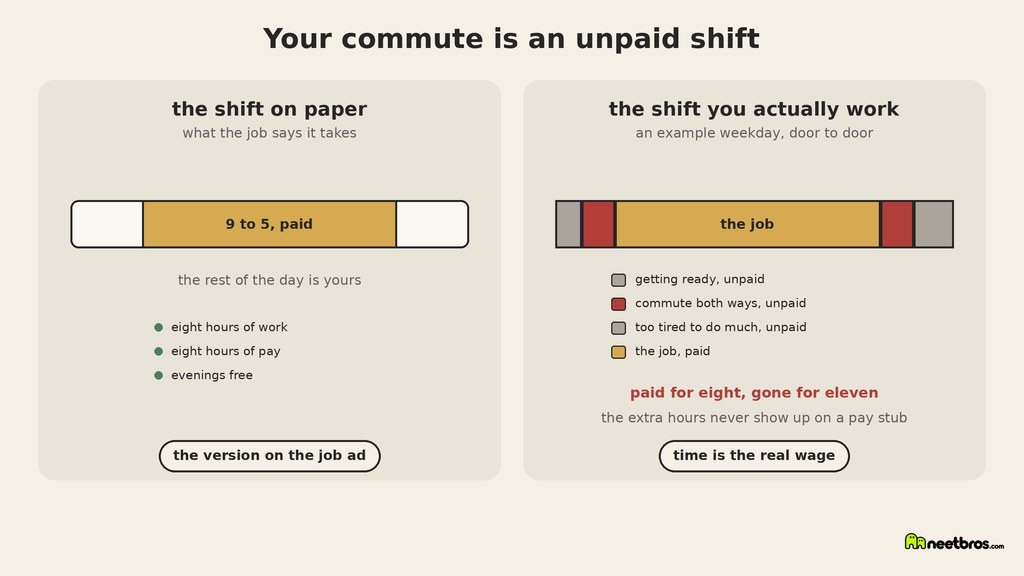
When people talk about how much a job takes out of you, they usually mean the hours on the schedule. Nine to five, or whatever the shift is. But nobody I know actually gives a job eight hours. They give it the hour before, getting ready and getting there. They give it the hour after, getting home and getting back to being a person. I started thinking of the commute as its own shift, one that shows up every single day and never shows up on a pay stub. Once you see it that way, a lot of the advice aimed at NEETs starts to look like it skipped some math.
WorkSocietyCommuteLess workEmploymentTimeUBINEET
Your commute is an unpaid shift
The hours nobody counts
Take an ordinary job with an ordinary commute. Half an hour each way, maybe more if you take a bus that comes when it feels like it. Add the time it takes to get dressed for being seen, pack something to eat, and stand around waiting for things to open. Then add the lunch break that is technically yours but that you spend in a building you did not choose.
Put it together and a day that pays for eight hours can easily take ten or eleven. That is not a dramatic case. That is just a normal weekday for a lot of people.
None of those extra hours are paid. They are not on the offer letter. They are not in the hourly wage you compare when you look at job ads. They just quietly come out of your life, every day, like a second shift you agreed to without being asked.
It costs money too
The commute does not just take time. It takes money. Bus passes, gas, parking, a car payment, insurance, repairs, the coffee you buy because you have been awake since six. Clothes that fit the office instead of your life. Takeout because you got home too tired to cook.
If you take the wage and subtract what it costs to show up, the real pay is lower than it looks. For a low wage job, sometimes a lot lower. Some people do that math and find they are working a full week to clear what feels like a part time income.
That is one of the things people mean when they say a job is not worth it. They are not being lazy. They are being accurate.
Return to office is a fight about time
During the pandemic a lot of office workers got their commute back for free. They did the same job from home and suddenly had an hour or two a day returned to them. People slept more. They cooked. They walked. They saw their kids in daylight.
Then many companies called everyone back in, and the arguments were mostly about culture and collaboration. But what people were really mourning was the time. They had felt what it was like to be paid for their work without also donating a shift to the road, and it was hard to un-feel that.
I think that tells us something. When people get time back, they do not usually fill it with nothing. They fill it with the parts of life that were getting squeezed out.
It hits people with less the hardest
The commute is not shared evenly. People with money can live close to work, or buy a car that does not break down, or work somewhere that lets them stay home. People without money often live far out where rent is cheaper and take the longest, least reliable trips to the lowest paying jobs.
So the jobs that pay the least often have the biggest hidden shift attached. That is a strange way to organize things. The person with the least time and money left over is asked to give the most of both just to get in the door.
For a lot of NEETs, this is part of why the entry level job does not add up. It is not that you cannot do the work. It is that the work comes bundled with two hours of unpaid travel and a pile of costs, and what is left at the end barely covers the effort.
Time is the real wage
We talk about pay as if money is the whole deal. But the thing you are actually trading is time, and you only get so much of it. A job that pays a bit more but eats three extra hours a day can leave you poorer in the way that matters most.
This is why I keep coming back to a basic income, or neetbux, as a floor. A floor is not only money. It is time back. It is the freedom to turn down the job that costs more to reach than it pays. It is the ability to work closer to home, or fewer days, or not at all for a while, without falling through.
A society that has the productivity we have should be able to give people some of their hours back. Instead we mostly turned the extra into longer drives and more meetings.
If you feel guilty for not wanting it
If you have looked at a job listing, done the math on the bus and the hours and the cost, and quietly decided it was not worth it, you are not broken. You did the accounting that the job ad left out.
Spend the hours you have on something that gives back. Sleep, a walk, a cheap hobby, people you like. And if it helps a little in the meantime, the AI you already pay for can claim paid micro-tasks for sats on neetbros.
Your time is not free just because nobody pays for it. It is the most valuable thing you have, and it is fine to protect it.
Fake jobs are UBI with a commute is about busywork that exists mostly to justify a paycheque. Where did the short workweek go is about the leisure we were promised. Working less is a climate plan is about what fewer hours could do for everyone. Bootstraps were always a joke is about why nobody rises without a floor. Rest is not something you earn is an older post on the same idea.
 Society