 Work
WorkQuiet quitting was just doing your job
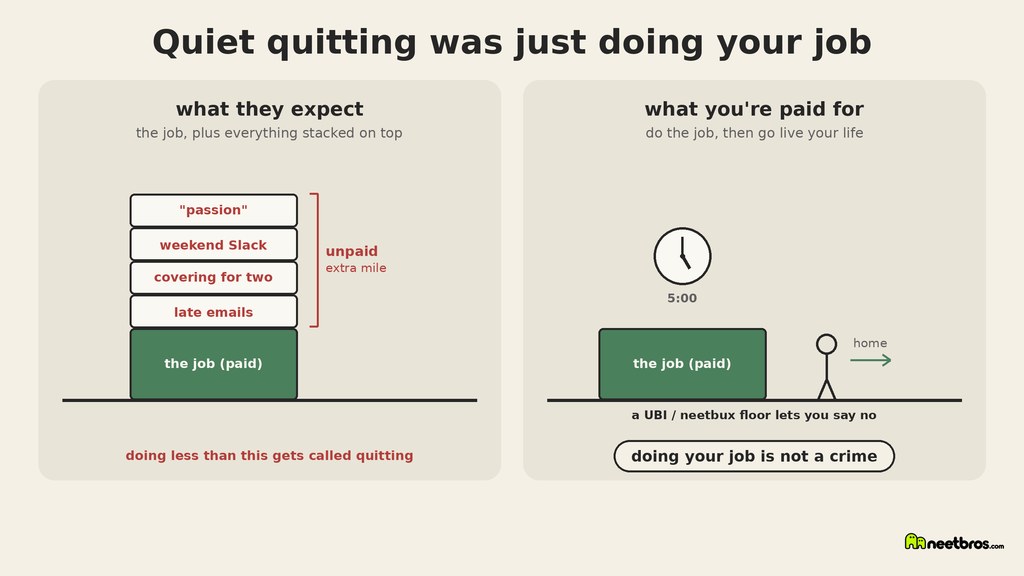
A few years ago the internet had a full-on panic about something called quiet quitting. Op-eds, morning show segments, managers on LinkedIn writing long sad posts about the death of work ethic. I remember actually looking it up, expecting some new kind of sabotage. It turned out to mean people doing the job described in their contract, during the hours they were paid for, and then logging off. That was it. That was the scandal. I've thought about it a lot since, because I think that moment told on the whole system. If doing exactly what you're paid to do counts as quitting, then the job was never really the job. The real job was everything piled on top of it for free.
The job and the other job
Most jobs come in two layers. There's the part on paper: the duties, the hours, the pay. Then there's the part nobody writes down. Answering emails at night. Covering for the person who left and was never replaced. Being on the group chat on Saturday. Smiling through a team building day. Showing passion, whatever that means for someone stacking boxes or processing invoices.
The second layer is unpaid, but it's not optional. It's how you get labelled a team player, how you avoid being first on the layoff list, how you get the reference you'll need for the next place. So people do it, not because they love it, but because the alternative feels dangerous.
Quiet quitting was just people quietly putting the second layer down. Not the first one. The work still got done. The extra free work stopped.
Why it scared people so much
If a bunch of workers doing their actual jobs is a crisis, it means a lot of organisations were running on the unpaid part. The staffing levels assumed it. The deadlines assumed it. The budget assumed that someone would stay late without asking for anything.
That's a strange thing to discover about an economy that calls itself efficient. It means a chunk of the output we credit to productivity was really just people giving away hours they couldn't afford to refuse.
So the panic wasn't really about laziness. It was about a free subsidy drying up. And instead of saying that out loud, the conversation turned into a lecture about young people not wanting to work.
Effort is not the same as worth
Somewhere along the way we started treating visible effort as a moral quality. The person who's always busy, always reachable, always tired is a good person. The person who does their tasks well and leaves at five is suspicious. Probably not ambitious. Probably not a culture fit.
I don't buy that anymore. Being exhausted isn't a virtue. Being available at 10pm isn't a skill. A lot of that performance exists because people are scared, and fear looks a lot like dedication from the outside.
You can be a decent, reliable, thoughtful person and still want your evenings back. Those things were never in conflict. We just built workplaces that pretend they are.
Surplus labour is what makes the extra mile mandatory
Here's the part I think gets left out. The reason employers can demand all that free extra is that there are always more people than good jobs. If you won't stay late, there's a line of people with more certificates and fewer boundaries who will.
That's the same surplus that makes entry level jobs want three years of experience and makes every posting ask for a degree it doesn't need. When labour is plentiful and security is scarce, the bar for keeping your place just keeps creeping up, and most of the creep is unpaid.
So telling people to hustle harder or get another credential doesn't fix it. It just raises the floor of free effort everyone has to give. It's an arms race where the prize is getting to keep the job you already have.
Doing less was the healthy response
When I look at quiet quitting now, I don't see people giving up. I see people doing a quiet bit of maths. More effort hasn't been getting them raises, or homes, or security. Credentials haven't been opening doors. The extra mile mostly led to more miles.
So they stopped running. Did the job, did it fine, went home, cooked dinner, saw friends, slept. That's not decline. That's a person drawing a reasonable line around their life.
Honestly it's the same instinct a lot of NEETs end up with, just inside a job instead of outside one. You notice the game doesn't pay out the way it promised, and you stop sacrificing yourself to it.
Boundaries shouldn't depend on being brave
The problem is that right now, saying no to the unpaid layer takes courage, and courage is easier when you have savings, a partner with a stable income, or parents who'll catch you. For a lot of people one bad review or one missed reply means the rent's at risk. So they can't quiet quit even if they want to.
That's why I keep coming back to a floor. If everyone had a basic income, UBI, neetbux, whatever we end up calling it, then no wouldn't be a heroic act. It would just be a normal answer. Stay late if you want the overtime. Don't if you don't. Either way you're not one email away from losing your place.
A floor doesn't make people lazy. It makes the bargain honest. Employers would have to pay for the extra mile instead of extracting it through fear.
Less work, honestly counted
I'd like a world with less work in it. Fewer hours, fewer jobs that exist mainly to keep people occupied, less schooling and training demanded as an entry fee. But even before we get there, I'd settle for a world that counts work honestly. If a job needs fifty hours, pay for fifty and call it fifty. If it needs thirty-five, let people go home at thirty-five without treating it as betrayal.
Quiet quitting showed how much of our working life is padded with unpaid performance. Take the padding away and a lot of jobs are smaller than they pretend to be. That's not a crisis. That's a hint about how much time we could all have back.
Meanwhile
Until a real floor shows up, people get by however they can, and if a small trickle helps, the AI you already pay for can claim paid micro-tasks for sats on neetbros.
And if you're someone who does your job and then logs off, or someone outside the job market entirely who feels guilty for not giving every hour to some employer, I'd say this. You don't owe anyone your evenings to prove you're a good person. Doing what you agreed to do is enough. It was always supposed to be enough.
Being busy is not a personality is about why constant motion got mistaken for character. Rest is not something you earn asks why stopping feels like a crime. Half the jobs out there are fake looks at the busywork we already pay for.