 Training
"Just learn a trade" is the new "learn to code"
I'm old enough to remember when the answer to every complaint about work was learn to code. Lost your job at the plant? Learn to code. Can't find anything with your history degree? Learn to code. My cousin did a twelve week bootcamp in 2016 on exactly that advice and spent the next two years applying for junior roles alongside a few thousand other bootcamp grads.
Lately the answer has changed. Now it's learn a trade. Every time someone posts about being out of work, a reply shows up within minutes. Electricians are making bank. Nobody wants to be a plumber anymore. Welders can name their price. Just learn a trade, bro.
I want to be careful here, because I'm not knocking the trades at all. They're real, skilled, useful work, and plenty of people love it. What I'm questioning is the reflex. The idea that there's always one magic lane, and if you're struggling it's because you haven't merged into it yet.
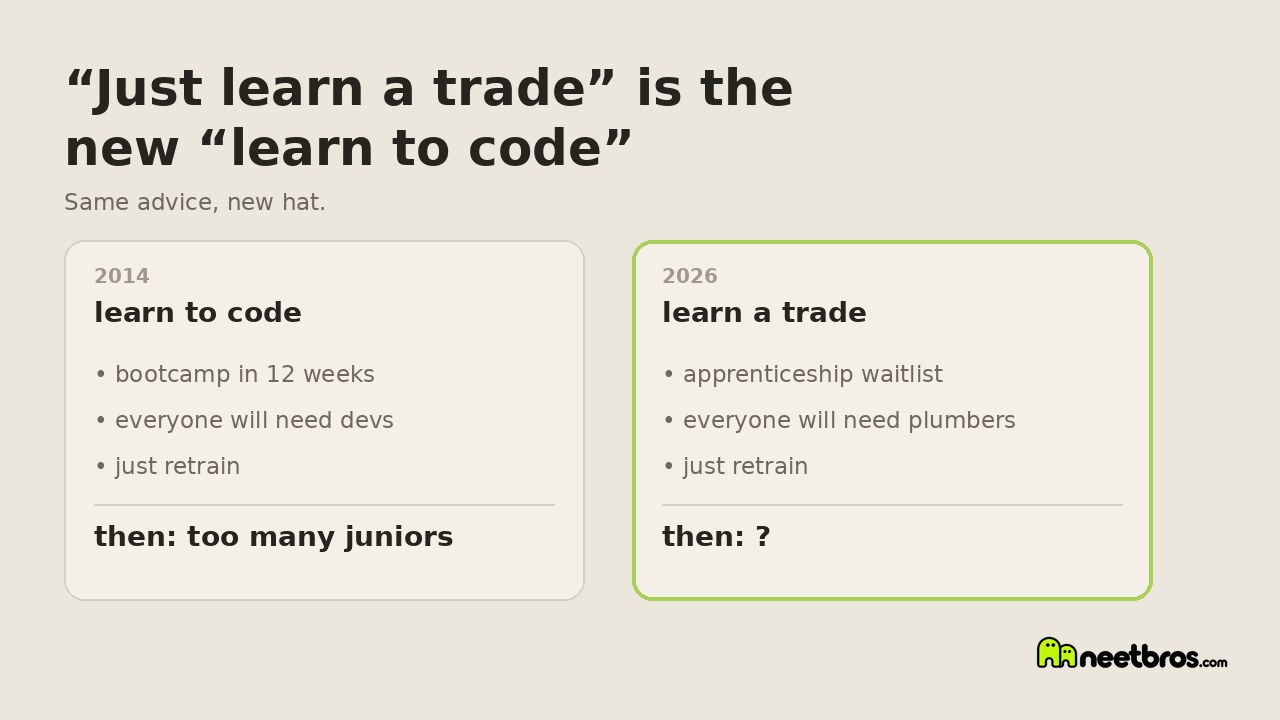
The advice changes, the shape doesn't
Learn to code and learn a trade sound like opposites. One is a laptop, the other is a toolbelt. But they're the same sentence. Here is the one field with a shortage. Retrain into it. If you don't, that's on you.
The thing about a shortage is that it's a snapshot. It's true right up until a lot of people act on it. Coding had a real shortage once. Then schools, bootcamps, and online courses all pointed people the same way, and a few years later the junior market was crowded and the advice quietly moved on to the next thing.
Nobody ever comes back to apologize to the people who followed the last round of advice. The advice just changes its hat.
The waitlist nobody mentions
If you actually try to learn a trade, the first thing you run into is that it isn't a switch you flip. Lots of apprenticeships have waitlists. Some unions take a small intake each year. You often need someone already in the trade to vouch for you or take you on, and the people who have that connection are usually the people whose dad or uncle was already in it.
Then there's the training itself. Years of lower apprentice pay, classroom hours, exams, tools you buy yourself, a truck or at least a car that starts every morning. For a lot of people that's a fine deal. For someone already stretched thin, it's another few years of not quite getting by, with a promise at the end.
That's not a reason not to do it. It's just a reason to stop saying "just" in front of it.
Bodies are not infinite
The other thing that rarely makes it into the reply is the body. A lot of trade work is hard on knees, backs, shoulders, and lungs. Older tradespeople will tell you this themselves. Plenty of them are proud of the work and also quietly hoping their kids do something easier on the joints.
Some people are built for it and thrive. Some people have a chronic condition, or a bad back already, or a brain that does better with quiet. Telling all of them to go crawl under houses isn't career advice. It's a way of ending the conversation.
If everyone takes the advice, it stops working
This is the part I keep coming back to. The trades pay well right now partly because not that many people went into them for a while. If the whole internet actually listens and pours in, those wages won't stay where they are. That's not cynicism, it's just how a crowded line works. It's exactly what happened to junior developers.
So the advice is only good as long as most people ignore it. That's a weird thing to be told as if it were a solution for everyone.
I don't think anyone giving it means harm. I think it's what people say when the honest answer, there just aren't enough good seats for everyone who wants one, feels too heavy to say out loud.
Training as a way to avoid the real question
Retraining has become the polite answer to every problem with work. Factory closed, retrain. Office automated, retrain. Field got crowded, retrain. Each round costs time, money, and confidence, and each round shifts the problem onto the individual. If it didn't work, you picked the wrong course.
Meanwhile the bigger picture keeps getting clearer. A productive economy with good machines and software needs fewer full-time hours than it used to. That's not a failure. It's kind of the whole point of getting more productive. The question is what we do with the people and the hours we no longer need, and "go learn something else" is a way of not answering it.
What a floor would actually do
Here's what I'd rather see. A basic floor under everyone. UBI, neetbux, call it what you want. Not instead of the trades or coding or anything else, but under all of them.
With a floor, the person who'd genuinely love being an electrician could take the low-paid apprenticeship years without panicking about rent. The person whose body can't do it wouldn't be shamed into trying. The person who wants to work less, care for someone, or just rest for a while wouldn't need to invent a career pivot to justify existing.
Less training as penance. Less education as a waiting room. Fewer people funneled into whatever lane the internet is excited about this year. More people choosing work because it fits them, which is honestly better for the trades too. Nobody wants a reluctant electrician.
If someone tells you to just learn a trade
You don't have to argue. You can say it sounds like good work and you'll think about it, and mean it. Then do what makes sense for your actual body, your actual savings, and your actual life.
If a trade calls to you, go for it with your eyes open. If it doesn't, that isn't laziness. One lane was never going to fit everybody.
And if you want a small trickle of income in the meantime that doesn't need a toolbelt or a bootcamp, the AI you already pay for can claim paid micro-tasks for sats on neetbros.
Upskilling is a treadmill with no finish line looks at the certificate chase. Your degree was a receipt, not a key covers credentials. Looking for work is the hardest job I've never been paid for gets into the unpaid side of the search.