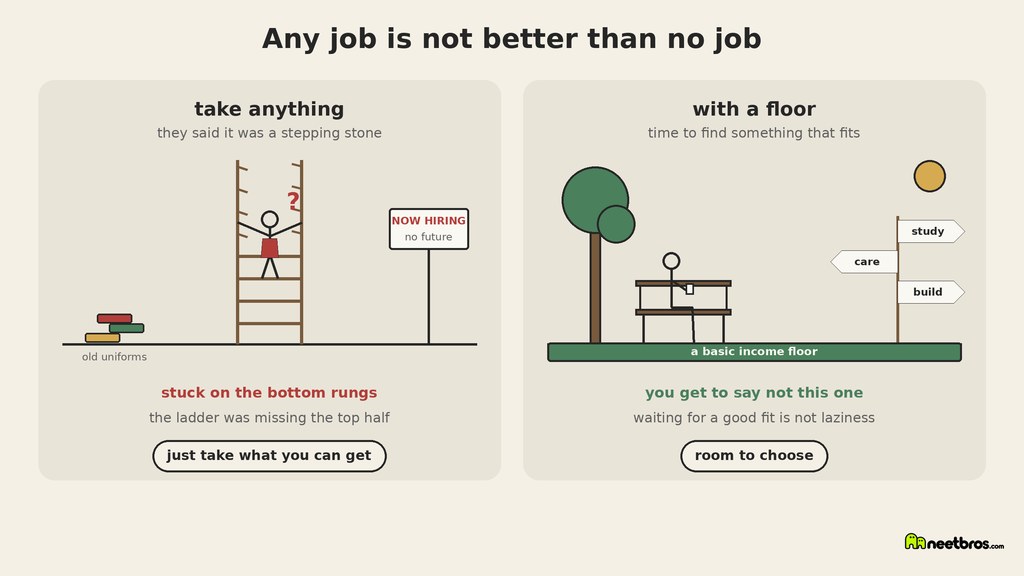
Almost everyone who has been out of work for a while has heard it. Just take something. Anything. It is easier to find a job when you have a job. Any job is better than no job. It is said kindly most of the time, by parents, by case workers, by friends who mean well. And it sounds like common sense. But I have watched a lot of people follow that advice, and I am not sure it holds up. I want to go through it slowly, because I think it is one of those lines that protects a system more than it protects the person hearing it.
The idea is that a low job leads to a better one. You start at the bottom, prove yourself, and climb.
Sometimes that happens. More often, people find the ladder is missing the top half. The shift work does not lead to the office job. The warehouse does not lead to management. You just get better at the job you already have, and then you get tired.
A stepping stone is only a stepping stone if there is somewhere to step to.
A bad job can follow you
There is a quiet cost to taking whatever is hiring. If you have trained for one thing and you take a job far below it, the next employer often reads that as a signal about you, not about the market.
People call it being underemployed. It tends to stick. The longer you spend in a job that does not use what you know, the harder it gets to go back, and the more your skills fade.
So the advice that was meant to keep you from falling behind can be the thing that keeps you there.
Rushing is not the same as helping
A lot of benefit systems are built around getting people off the books fast. Apply to so many jobs a week. Take the first offer or lose your support.
On paper that looks efficient. In real life it pushes people into jobs they leave a few months later, burnt out or let go, and then they are back where they started with less energy and a worse story to tell.
Finding the right work takes time. Matching a person to the right place is slow, and pretending it is not just means doing it badly over and over.
Who the advice really serves
Any job is better than no job is a very convenient belief for anyone who runs a business with high turnover and low pay. It keeps a steady supply of people willing to take shifts nobody wants, on terms nobody would choose.
It also keeps the unemployment number looking nice. A person stocking shelves at night with a degree they cannot use counts the same as anyone else with a job.
None of that means the person is doing well. It just means they are no longer counted as a problem.
There are more people than good jobs
The bigger issue underneath all this is simple. There are not enough good jobs for everyone who wants one. Machines and software keep getting better at the work, and the jobs left over are often split into thinner and thinner pieces.
When there are more people than decent positions, telling everyone to grab whatever they can does not create more good jobs. It just decides who ends up in the bad ones.
That is surplus labour, and no amount of individual hustle changes the math.
What a floor would change
A basic income, or neetbux, would give people time. Time to look properly. Time to learn something on purpose instead of in a panic. Time to say not this one, and wait for something better.
Employers offering rough jobs would have to make them less rough, because people could afford to pass. The jobs that are genuinely useful would still get filled, by people who actually chose them.
And the people who are not working right now would not be pushed into the nearest opening just so a form can say they tried.
Waiting is not laziness
If you are holding out for something that fits, you are not being picky or entitled. You are trying not to lose years in the wrong place. That is a reasonable thing to want.
It is fine to be a NEET while you figure it out. It is fine to rest, to learn, to help people around you, and to take your time. A good fit later is often worth more than a bad fit now.
And if you want a little income in the meantime, the AI you already pay for can claim paid micro-tasks for sats on neetbros.
Overqualified is a polite word for not enough jobs is about degrees that the market does not need. The job market is musical chairs is about there being fewer seats than people. Help shouldn't feel like a trial is about benefit systems that treat people as suspects. Looking for work is a job that pays nothing is about the hidden labour of job hunting.
 Society