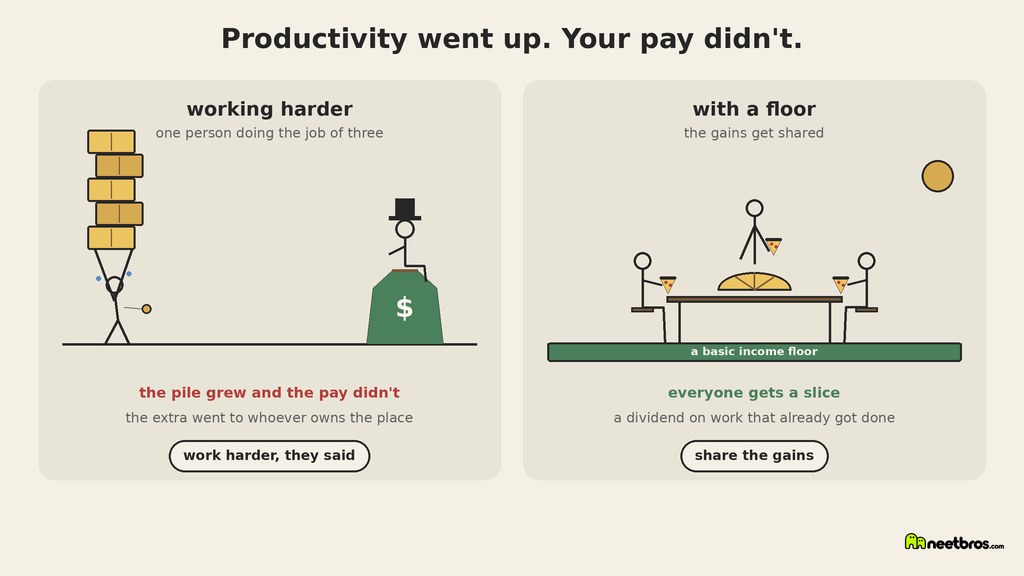
There is a line chart that gets passed around every few months. One line is how much a worker produces in an hour. The other is what a typical worker gets paid for that hour. For a long time they moved together. Then, somewhere around the 1970s in a lot of rich countries, they split, and they never really came back. I am not going to throw numbers at you, because people argue about exactly how to measure it. But almost everyone who looks at it agrees on the shape. We got a lot better at making things. Most people did not get a lot better off. I think that shape explains more about why work feels the way it does than any productivity podcast ever will. So I want to sit with it for a bit.
Every generation of workers was told the same thing. Get more skilled, use the new tools, be more efficient, and you will be rewarded.
And people did. One person now handles what used to take a small team. Email replaced the mail room. Software replaced the typing pool. A spreadsheet does in a minute what used to take a week.
The work got done faster. The deal was that you would share in that. For most people, that part of the deal quietly never arrived.
So where did it go
The extra did not vanish. It went somewhere. Mostly it went to the people who own things: shares, buildings, companies, patents. Some of it went to the very top of the pay scale.
That is not a conspiracy. It is just what happens when the people doing the work have less and less power to ask for their cut. Unions shrank. Jobs got easier to move or automate. Everyone became replaceable on paper, and replaceable people do not get raises.
So the gains piled up where the leverage was, not where the effort was.
Working harder cannot fix this
This is why hustle advice feels so hollow. If the split between workers and owners is decided above you, then working harder mostly just makes the pile bigger for someone else.
You can grind your way up a little, sure. A few people do. But you cannot grind your way out of a pattern that covers a whole economy. The math does not care how early you wake up.
It is a bit like being told to row faster on a boat whose course was set by someone else.
The rent noticed, even if your boss didn't
Meanwhile the things that matter most got more expensive. Housing, school, child care, health. The basic cost of a normal life kept climbing while the pay for an ordinary job crawled.
So people work as much as their parents did, often more, and end up with less security. That is not a personal failing. That is what it feels like to live on the wrong side of that chart.
More output, fewer people needed
There is a second part to this. When each worker can do more, you need fewer workers to make the same amount of stuff.
In a fair world that would mean shorter weeks for everyone. Instead we kept the long week and let the extra people fall out of the bottom. Some of them are the NEETs reading this.
That is surplus labour. It is not that you are useless. It is that the system got so efficient it stopped needing everyone, and then blamed the people it stopped needing.
A floor is a way to share the gains
A basic income, or neetbux, is one simple way to send some of that extra back to people. Think of it as a dividend on all the productivity we built together over decades, paid to everyone just for being part of the society that made it.
It would not ask you to prove you worked hard enough. It would just recognise that the work already got done, a long time ago, by a lot of people who never got paid for the full value of it.
And with a floor under them, people could afford to work less, push back on bad deals, or take time to do things that matter but do not pay.
You are not lazy for noticing
If you look at all this and feel less motivated to grind, that is not a character flaw. That is a reasonable reaction to an arrangement that was not built in your favour.
It is fine to do less. It is fine to care more about your time than about squeezing out a little more output for someone else's quarterly report.
And if you want a bit of income on the side, the AI you already pay for can claim paid micro-tasks for sats on neetbros.
Who gets paid when the machines do the work is about automation and who keeps the savings. Where did the short workweek go is about the leisure we were promised. Less work is the point of progress is about what efficiency was supposed to buy us. We produce enough, we ration dignity is about plenty and scarcity living side by side.
 Society