 Job hunting
Looking for work is the hardest job I've never been paid for
Last month I kept a little timesheet, half as a joke. Every hour I spent looking for work went into a spreadsheet, the same way I'd log hours if someone was paying me. I wanted to know if I was actually being lazy, like the voice in my head kept saying.
By the end of the month I had logged more hours than my part-time job used to give me. Tailoring resumes. Writing cover letters nobody reads. Re-typing the resume into portals that just asked me to upload the resume. A take-home project for a company that ghosted me after I sent it.
The total pay for all of it was zero. I'm not writing this to complain, exactly. I just think we should be honest about what the job search has turned into, because a lot of people who look idle from the outside are quietly working a second, unpaid job that never ends.
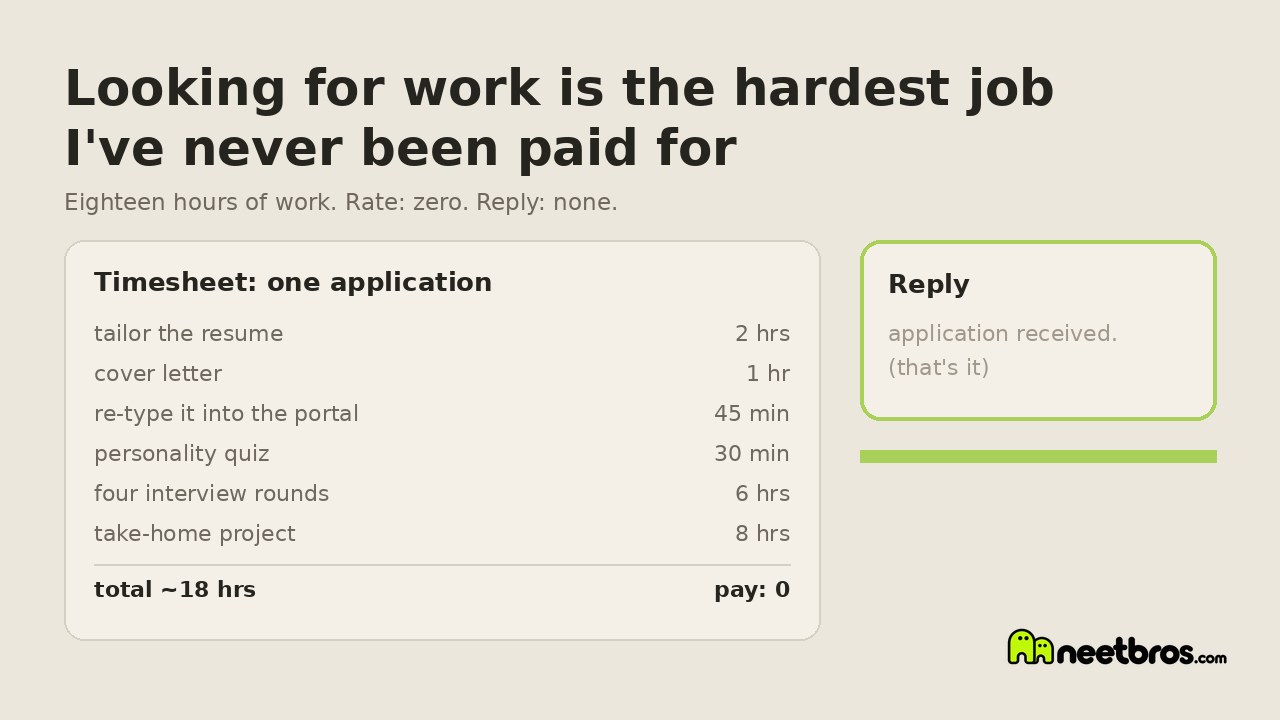
One application is a small project now
Applying used to mean a resume and a handshake. Now a single serious application is a little project. You study the posting, rewrite your resume so the keywords match, write a custom cover letter, make an account in yet another portal, then type your whole work history in again by hand because the parser mangled it.
Some places add a personality quiz. Some add a recorded video interview where you talk to your own webcam with a timer counting down. Some want references before they've even spoken to you.
None of this is evil. Each step probably made sense to someone in a meeting. But stacked together, it means one application can eat an afternoon, and you're told to send dozens a week.
The interview loop keeps growing
If you get through, the loop starts. A screening call, a call with the hiring manager, a panel, a call with the team, a final round with someone senior who asks the same questions as the first person. Four or five rounds for a role that would have been one conversation not that long ago.
Then the take-home assignment. Build a small feature, write a marketing plan, analyze a spreadsheet, it should only take two or three hours. It never takes two or three hours. It takes a weekend, because you know fifty other people are doing it too and yours has to stand out.
That's real work. Skilled work. It just happens to be work done for free, by people who mostly won't get the job, for companies that will often never say thank you.
Then nothing
The part that gets people isn't the rejection. Rejection is fine, it's information. The part that gets people is the silence. You do eighteen hours of work across a month for one role and the last message you ever receive is an automated email saying your application was received.
Sometimes the role was never really open. Ghost postings sit up for months so a company looks like it's growing, or so it can collect resumes for later. You can't tell which ones are real, so you treat all of them as real, and you do the work for all of them.
If a contractor treated a client this way, nobody would call the contractor lazy for being tired.
This isn't about bad recruiters
I want to be fair here. Most recruiters are swamped. They get a thousand applications for one seat, and the hoops are their way of thinning the pile. It's not a conspiracy. It's what happens when there are far more capable people than there are roles.
That's really the core of it. A productive economy with good machines and good software just doesn't need everyone in a full-time seat anymore. That's surplus labor, and the job search is where you feel it most. The hoops multiply because the line is long, and the line is long because the seats didn't grow with the population of people qualified to fill them.
So everyone does more unpaid work to compete for the same number of chairs. That's not the market failing, exactly. It's just a lot of wasted human effort that nobody counts.
What a floor would change
Here's what I keep coming back to. If there were a basic floor under people, UBI, neetbux, whatever you want to call it, the job search would stop being a panic. You could apply to the five roles you actually want instead of the ninety you're told to log. You could say no to the unpaid weekend project. You could take a month to recover after a rough one.
Employers would probably benefit too. Fewer desperate mass applications, more people who actually want the specific job. Less theater on both sides.
And the people who decide they'd rather not chase a seat at all could stop pretending. Less employment as performance. Less training as a way to look busy. More time for the stuff that actually holds a life together.
If you're in the middle of it
If you're deep in the search right now and feeling like a failure, try logging your hours for a week. Not to guilt yourself into more, but to see the actual number. Most people are shocked. You're not idle. You're doing a job that just doesn't pay.
Be kind to yourself about the silence. It isn't a verdict on you. It's a pile that's too big for anyone to answer.
And if you want something calm on the side, the AI you already pay for can claim paid micro-tasks for sats on neetbros. No portal, no five rounds.
Getting help shouldn't feel like being on trial covers the weekly job search diary. Your parents' advice was for a different economy looks at why walking in with a resume stopped working. Half the jobs out there are fake gets into busywork once you're inside.