 Work
WorkThe gap in your resume is not a confession
Every job interview I've had in the last few years eventually gets to the same question. It comes after the small talk and before the salary stuff, usually with a little head tilt. So, I see there's a gap here. Can you walk me through that?
And every time, I feel myself shift into defense mode. Like I'm being asked where I was on the night of the crime. I have a rehearsed answer. I was upskilling, I was caring for family, I was exploring opportunities. Some of it is even true.
But I've started wondering why the gap needs an alibi at all. That's what this post is about.
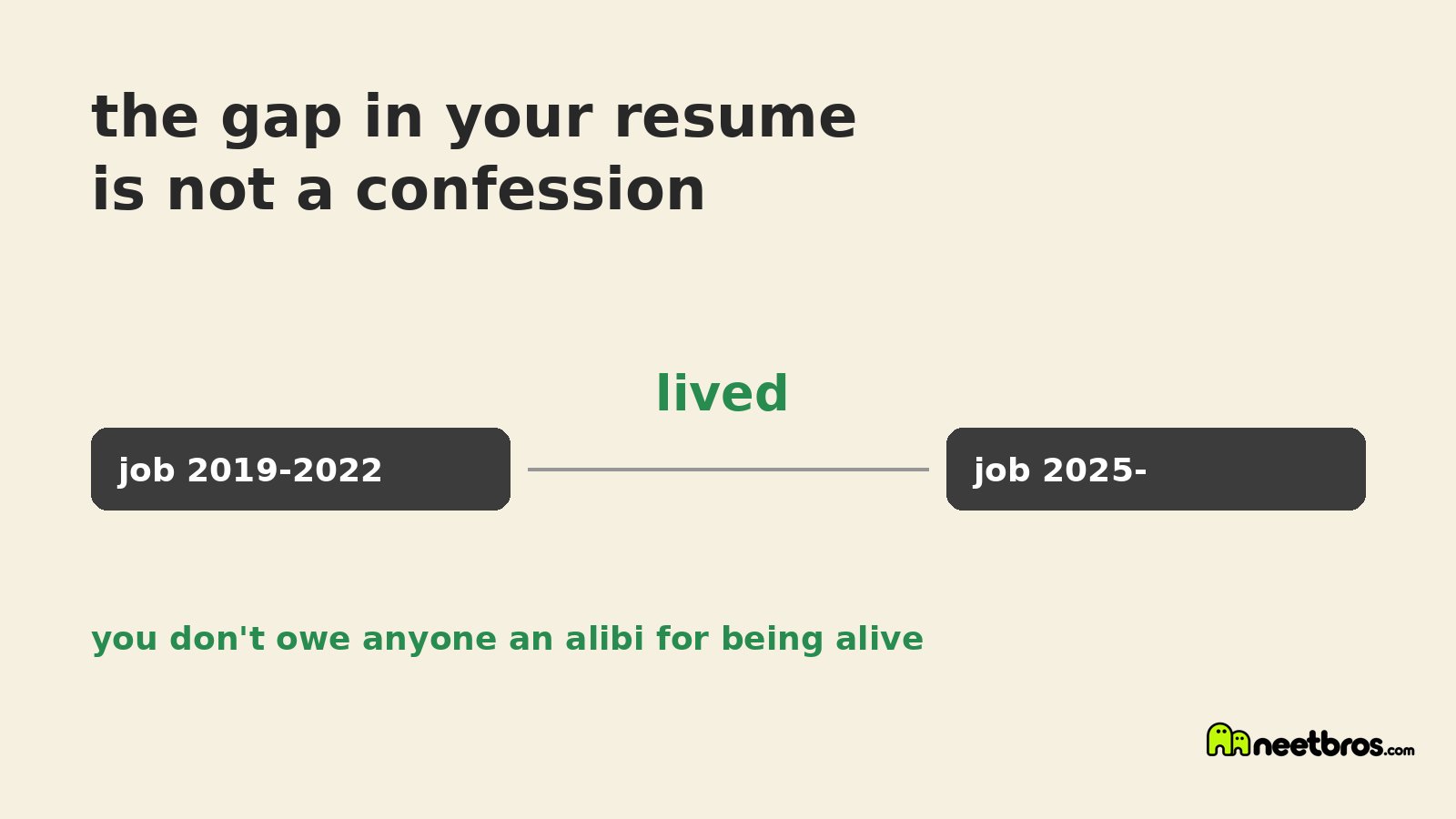
The timeline is supposed to be solid
The modern resume assumes something weird. It assumes that from the day you leave school until the day you retire, every month should be accounted for by an employer or a credential. Any white space is suspicious. Six months is a yellow flag. Two years is a story you'd better tell well.
Nobody actually lives like that. People get sick. Parents get sick. Industries collapse. Burnout happens. Sometimes you just need a year where nothing is asked of you. Sometimes the jobs simply aren't there, no matter how many applications you send.
The resume pretends all of this is rare and personal. It's not. It's most people, at some point.
The gap is usually the economy, not you
When a factory closes, the gap shows up on a few hundred resumes at once. When a sector automates, it shows up on thousands. When a recession hits, a whole generation gets a gap stamped on them in the same year. Then each person sits in an interview and explains it like it was a private failing.
There's a lot of surplus labor out there. More people who could work than jobs that need doing, especially jobs that pay enough to live on. A gap is often just what it looks like to be on the wrong side of that math for a while.
Treating it as a character flaw lets everyone off the hook except the person who has the least control over it.
What people actually do in the gap
Ask around and the gap is full of stuff. Raising kids. Looking after a grandparent. Getting healthy again. Helping a friend through something. Fixing up a house. Learning to cook. Reading things nobody assigned. Being bored long enough to figure out what you actually care about.
None of that counts on paper. A year of unpaid caregiving is worth less on a resume than a year of filling in spreadsheets nobody reads. That says a lot more about how we measure value than about the people doing the caring.
Some of the most grounded people I know have huge gaps. They're not lost. They just stopped pretending the timeline was the point.
The fear of the gap keeps people stuck
Here's the part that bothers me most. Because everyone knows gaps get punished, people stay in jobs that are making them sick. They take the first bad offer instead of waiting for a decent one. They sign up for another course they can't afford just so the dates look continuous.
So the gap penalty doesn't just hurt people who have gaps. It shapes everyone else's choices. It makes the whole labor market more anxious, more desperate, and easier to squeeze.
A lot of credential chasing and hustle is really just gap insurance. Not growth. Not ambition. Fear of white space.
A floor would make the gap boring
I keep landing in the same place. If everyone had a basic floor, UBI, neetbux, call it whatever, a gap would stop being scary. It would just be a period where you were living on the floor instead of on a paycheck. Nobody would need a cover story.
You could leave a bad job without a plan. You could take a year to recover. You could care for someone without watching your future shrink. And employers would have to compete a bit harder, because people wouldn't be quite so desperate to close the gap at any cost.
Less work as proof of worth. Less training as filler. Less pressure to keep the timeline solid. More room to just be a person for a while.
If you're sitting in a gap right now
You're not behind. You're not broken. You're doing something extremely common in a system that likes to pretend it's rare. If anyone asks, you can tell them the plain truth, or a short version of it, without the apology attached.
If you want a little income without it touching your resume, the AI you already pay for can claim paid micro-tasks for sats on neetbros.
And if nobody asks, even better. The gap isn't a confession. It's just part of your life.
Looking for work is the hardest job I've never been paid for covers the unpaid grind of the job search. Upskilling is a treadmill asks why the training never ends. Rest is not something you earn looks at why stopping feels like a crime.