 Surplus
We produce enough. We ration dignity.
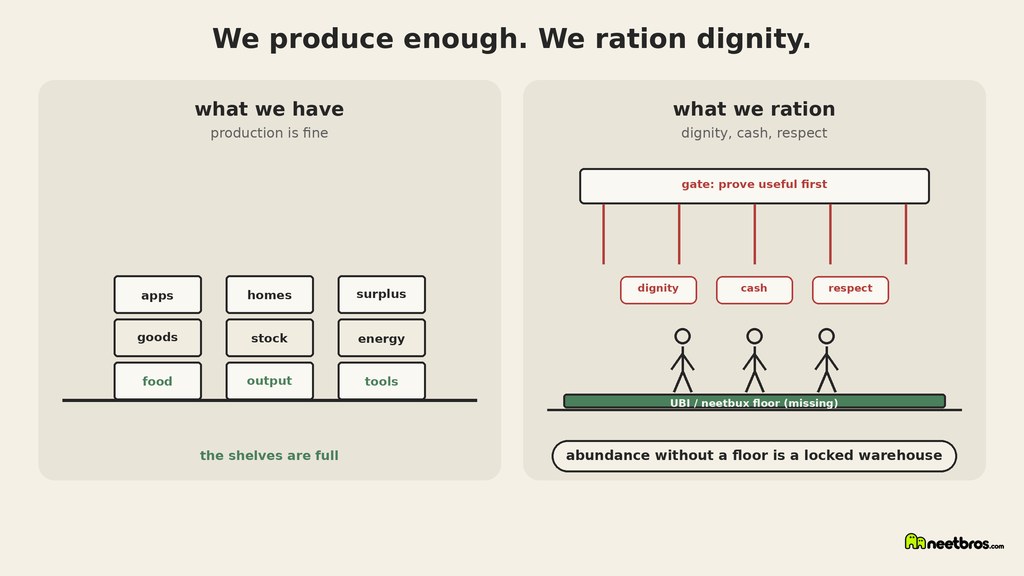
I keep coming back to a weird contradiction. Walk through any big city and you can see surplus everywhere. Empty office floors. Grocery aisles that never run out. Apps delivering anything overnight. Factories that could make more if someone asked. We are not, in any serious sense, a society that can't feed or house people. And yet the daily story we tell about unemployment, NEETs, gig workers and anyone outside a tidy job is still about scarcity. Scarcity of grit. Scarcity of skills. Scarcity of hustle. As if the warehouses were empty and the only missing ingredient was your character. I think we've got the diagnosis backwards. We produce enough. What we ration is dignity — and the cash and respect that travel with it.
Abundance of stuff, scarcity of floors
Start with the plain observation. Rich countries already generate more goods and services than they know what to do with. Food gets thrown out. Clothes sit in overstock. Software gets written once and copied a million times. Housing is often held empty or underused while people sleep in cars. The bottleneck is not whether the economy can output enough. The bottleneck is who is allowed to claim a share without performing the right kind of usefulness.
That's why the mood around surplus labour feels so gaslighting. You're told there's not enough to go around, then you watch companies announce record output with fewer staff, and warehouses full of stuff nobody can afford without a wage. The scarcity isn't of product. It's of permission to live.
Once you see that, a lot of the moral lectures start sounding like inventory management for people. Keep the surplus workers anxious enough and they'll accept worse terms, longer unpaid prep, more credentials as penance.
Surplus labour isn't a character flaw
If there are more people than good paid seats, some people will be outside those seats. That isn't a personality failure. It's arithmetic. Musical chairs doesn't get kinder because the people left standing practise gratitude harder.
I've spent years being told the opposite. That if I just wanted it more, networked better, retrained into the hot field, smiled through another unpaid trial, the chair would appear. Sometimes a temporary seat does appear. Then it disappears again, and the speech resets. Want more. Be more. Build character.
The speech never updates for the fact that the labour market can stay oversupplied for a long time — especially when technology, consolidation and "efficiency" keep squeezing headcount while population and credentials keep rising. Treating that as a private shame is how policy offloads itself onto individuals.
Employment as penance
In that setup, having a job stops being mainly about producing something needed and starts being about proving you're not dead weight. Any job. Bad job. Fake busy job. Job that exists mostly so someone can say you're employed. The content of the work matters less than the status of being inside the machine.
That's why people get pushed into roles that barely pay, chew their health, or could be automated tomorrow. The point isn't always the output. The point is the ritual. Clock in. Look occupied. Collect just enough to stay in the respectability club.
I'm not against useful work. I've done work that mattered and work that didn't. What I resent is the idea that the only acceptable life is continuous employment, even when society clearly doesn't need every body in a paid seat every hour. That's penance dressed as productivity.
Credentials and training as the toll booth
When the seats don't multiply, the gatekeeping does. Another certificate. Another bootcamp. Another unpaid internship. Another year of "building experience" that somehow never counts as experience. Education and training become the toll booth you pay to stay in the queue for dignity.
I'm not anti-learning. Learning is one of the few good things humans do when they're not panicking. But forced upskilling as the answer to surplus labour mostly just raises the entry fee. Everyone runs harder on the same treadmill, and the wage floor barely moves.
The quiet message underneath is: if you're outside paid work, you must buy your way back with unpaid effort. Suffer correctly and maybe we'll let you back into the ration of respect. That's not a skills policy. That's a purity test with tuition attached.
Hustle is how we launder the rationing
Hustle culture is the friendly face of the same rationing. It says the pie is there if you grind. Side projects. Personal brand. Always be pitching. Always be improving. If you're still broke, you must have ground wrong.
I understand why it sells. It gives people a sense of agency in a system that feels closed. And sometimes a hustle does land. But as a social story it does something uglier: it turns structural underpayment into a motivational genre. The warehouses stay full. The floors stay missing. The podcasts stay loud.
When dignity is rationed through performance, hustle becomes the audition. You're not just earning. You're continuously proving you deserve to keep eating.
Dignity should not be a gated resource
Dignity is a strange thing to ration in a rich society. It isn't like rare earth metals. Giving someone a basic income, a place to live, and the right to exist without a mission statement doesn't take dignity away from someone else. Respect isn't a zero-sum inventory.
And yet we act like it is. People without jobs get spoken to like unfinished products. People on benefits get means-tested into exhaustion. People with resume gaps rehearse shame scripts for interviews. Cash gets treated as a prize for the correctly employed, not as a floor under everyone who lives here.
I don't think most people consciously want that. I think they inherited a story where worth travels with a paycheck, and they haven't noticed the paycheck stopped being available at scale. So they keep rationing dignity as if the old story still fits the maths.
A floor is how abundance becomes shared
If we already produce enough, the honest next step is a floor. UBI. Neetbux. Basic income. Call it whatever survives the branding wars. A cash baseline that doesn't require you to win musical chairs first.
A floor doesn't stop anyone from working. It stops work from being the only ticket to food, housing and a little respect. It lets volunteering be voluntary. It lets education be curiosity instead of penance. It lets people refuse bad deals without their life collapsing. It turns surplus labour from a moral panic into a solvable distribution problem.
That's the shift I want. Less employment-as-penance. Less credential-as-toll. Less hustle-as-audition. More time that belongs to people. More dignity that isn't gated. More of the abundance we already make actually reaching the humans standing next to it.
Meanwhile
Until a real floor shows up, people get by however they can, and if a small trickle helps, the AI you already pay for can claim paid micro-tasks for sats on neetbros.
And if you're tired of being told the problem is your character while the shelves stay full, I'd say this. Noticing the rationing isn't entitlement. Wanting dignity without a performance review isn't laziness. It's noticing that abundance without a floor is just a warehouse with a locked door.
Find your purpose is not a social policy is about lectures stacked on surplus labour. Full employment is a weird goal for a rich country questions why everyone busy beat everyone okay. Less work is the point of progress argues that progress should mean fewer hours, not more penance. The job market is musical chairs is the arithmetic version of the same problem. Quiet quitting was just doing your job looks at unpaid extras dressed up as virtue.