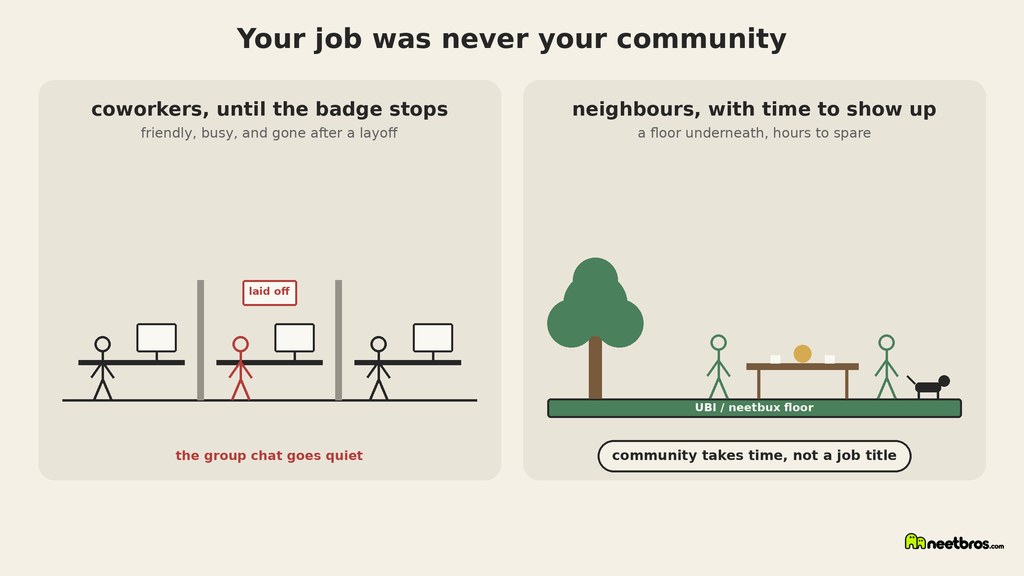
One of the softer arguments against people like us goes like this. It is not about money. It is about loneliness. You need a job, people say, because that is where you meet people. That is where your friends come from, your routine, your sense of belonging. Without it you will just drift. I get why people say it, and there is a grain of truth in it, because a lot of adults really do have no other place left where they see the same faces every week. But I think that is the problem, not the proof. If the job is the only community most people have, it is worth asking what happened to all the other ones.
I am not going to pretend nobody makes friends at work. People do. Some of them are great. You eat lunch together, complain about the same manager, cover for each other.
But almost everyone has noticed what happens when one of you leaves. The farewell card goes around, everyone says let's keep in touch, and then three months later you realize you have not spoken. Not because anyone was fake, but because the thing holding you together was a shared building and a shared boss.
That is what a workplace community is. It is a group of people assigned to the same place by someone else, for reasons that have nothing to do with them. It can be warm. It is still on loan.
A layoff is a social event too
When a company cuts staff, we talk about it as a money problem, and it is. But it is also the moment a lot of people lose their entire social world in one email. The group chat goes quiet. The badge stops working. The routine that structured every weekday is just gone.
If your sense of belonging can be revoked by a cost-cutting spreadsheet, it was never really yours. It belonged to the employer, and they lent it to you for as long as you were useful.
That is a fragile way to build a society. We tie people's income, healthcare, identity and friendships all to the same thread, and then act surprised when cutting the thread wrecks them.
Long hours are what emptied everything else
People used to belong to a lot of things that were not jobs. Bowling leagues, churches, union halls, neighbourhood associations, volunteer fire departments, choirs, card nights. The political scientist Robert Putnam wrote a whole book, Bowling Alone, about how much of that faded in the late twentieth century.
There are a lot of reasons for it, and nobody should pretend there is only one. But one of them is boring and obvious: those things need time. Weeknight evenings. Saturday mornings. Energy left over after the commute.
When two adults in a household both work full time, and the commute grows, and the job follows you home on your phone, the first things to go are the ones that were not paid. Then we look around at an emptied-out social landscape and tell people the job is the only community left. Well, yes. The job ate the others.
The lonely NEET is a real person
I do not want to wave away the loneliness. A lot of NEETs are isolated, and it hurts. Days blur together. It is easy to stop talking to anyone. That is worth taking seriously.
But notice what usually causes it. It is not the absence of a boss. It is the absence of money to go anywhere, the shame that makes you avoid people who will ask what you do, and the fact that everyone you know is too tired after work to hang out on a Tuesday.
None of that is fixed by pushing someone into a warehouse shift. Plenty of people are lonely at work too. You can stand next to someone for eight hours and never really know them.
Community runs on free time
If you wanted to rebuild the kind of belonging people miss, you would not start with more employment. You would start with time and a little security.
A basic income, UBI, neetbux, whatever we end up calling it, does both. It takes the edge off the money problem, so a coffee or a bus ticket or a club fee is not a crisis. And it lets people choose fewer hours, which is the raw material every other kind of community is made from.
Picture what people would do with a few extra afternoons and no fear of missing rent. Coach a kids' team. Run a game night. Help a neighbour move. Sit with a grandparent. Show up to the boring local meeting. Those are the things a society actually stands on, and almost none of them pay.
Meanwhile
Until that floor exists, people stitch together whatever they can, and if it helps a little, the AI you already pay for can claim paid micro-tasks for sats on neetbros.
And if you are not working right now and someone tells you that you need a job so you will not be lonely, it is fair to answer that what you need is people, and people are not a perk your employer gets to hand out.
So what do you do is the wrong question is about being introduced by your job title. A small life is not a failed life is about the dignity of living quietly. Caregiving is work nobody pays for is about the unpaid labour that holds families together. Being busy is not a personality is about why exhaustion became a status symbol. Working less is a climate plan is about what all those extra hours cost.
 Belonging