 Stolen time
We were promised a short workweek. Where did it go?
Back in 1930 Keynes wrote that his grandkids would probably work something like fifteen hours a week, because machines would get so good at making stuff that we'd run out of reasons to grind. He wasn't some fringe guy. He was the economist. And he was mostly right about the machines. He was just wrong about who'd get to keep the time.
We're the grandkids now. The machines got good. Then the software got good. Now the AI is getting good. And somehow the answer is still forty hours, plus commute, plus the unpaid hour of answering messages in bed, plus a side hustle because the forty doesn't cover rent. Nobody ever sat us down and explained where the short week went. It just quietly didn't show up.
This post is for people who noticed. Less work, less employment as a loyalty test, less school and less training as the price of admission. More floor. Not because we're lazy, but because the math already said we could.
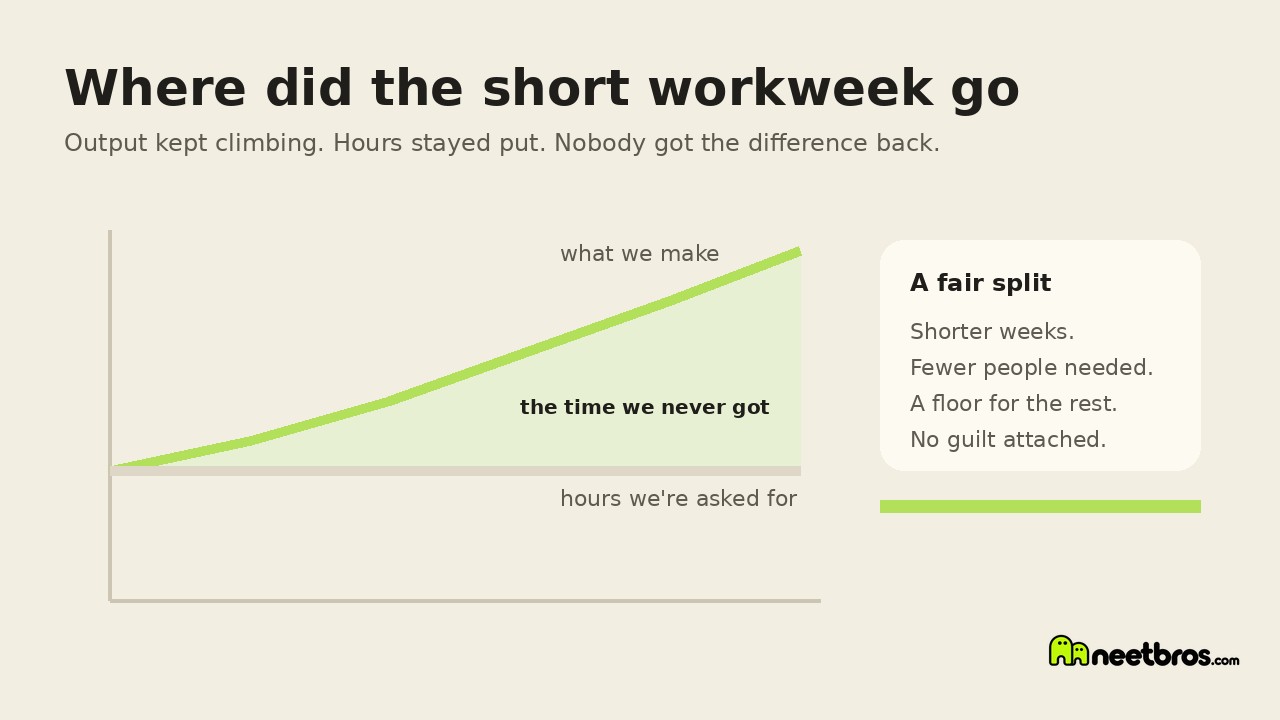
The gains went somewhere, just not to your evenings
Every time a job gets easier, there are two ways to spend the win. You can give people the same pay for less time, or you can keep the time and pocket the difference. We picked the second one basically every single time, and then called it growth.
So the extra didn't turn into Fridays off. It turned into more output per person, fewer people per office, and a lot of very nice quarterly calls. Some of us got cheaper TVs. None of us got our afternoons back.
I don't think that was a conspiracy. It was just the default. Nobody had to choose to steal the short week. They just had to not choose to give it out.
If one person can do the work of three, two people are surplus
Here's the part nobody likes saying out loud. If the work gets done with fewer hands, there are hands left over. Those people don't evaporate. They become the long-term unemployed, the underemployed, the guy with two degrees stacking shelves at night, the kid who stopped applying after the hundredth silent rejection.
We could have split the remaining work. Everyone does less, everyone eats. Instead we kept full-time for some and nothing for the rest, then told the rest it was a character problem. That isn't a labor market. That's musical chairs where the losers get lectured.
When you see it that way, being a NEET stops looking like personal failure and starts looking like what happens when society refuses to share the short week. Somebody has to be the leftover. Lately it's a lot of us.
More school doesn't add chairs
The standard fix is always more credentials. Go back to school. Do the certificate. Learn to code, then learn AI, then learn whatever comes after AI. Every round costs money and years, and every round the number of chairs stays the same.
Training doesn't create jobs. It just reshuffles who's standing when the music stops. If everyone gets a master's, the master's becomes the new high school diploma and the line just gets more expensive to stand in.
Less education as a waiting room. Less training as penance. If there aren't enough seats, making people pay for a nicer place to wait isn't kindness. It's a toll booth with a graduation gown.
A floor is just the short week, paid out in cash
UBI sounds radical until you see it as the thing Keynes was describing in different clothes. If the machines can carry more of the load, then some of the value they make can land in everyone's account, and people can work less, or not at all, without starving or being shamed.
Neetbux is the meme version of that. A boring deposit that says you exist, so you get a floor. No interview, no cover letter, no proving you've suffered enough this month. The short week, but honest about the fact that for some people the right number of hours is zero.
And honestly zero isn't the scary part. People still garden, care for parents, fix bikes, make dumb art, help neighbors, raise kids. That's work too. It just doesn't come with a badge, so nobody counts it.
Rest is not a reward you earn
The deepest damage isn't money. It's that we've been trained to feel guilty about time that isn't sold. A free Tuesday feels like a crime. A nap feels like evidence. We grew up being told rest is what you get after you've earned it, and then the earning never ends.
Dignity would mean your hours belong to you by default. You can sell some if you want to. You don't have to sell all of them to be allowed to exist. That was always the promise of all this progress. We just never collected.
One small optional thing: if you already pay for an AI that sits around most of the day, neetbros is a place it can claim paid micro-tasks for sats. Let the machine do the shift for once.
Your parents' basement is the welfare state nobody admits exists covers where the leftover people actually end up. Neetbux is just UBI with a meme name covers the floor itself. Read them slowly. You've got time. That's kind of the point.