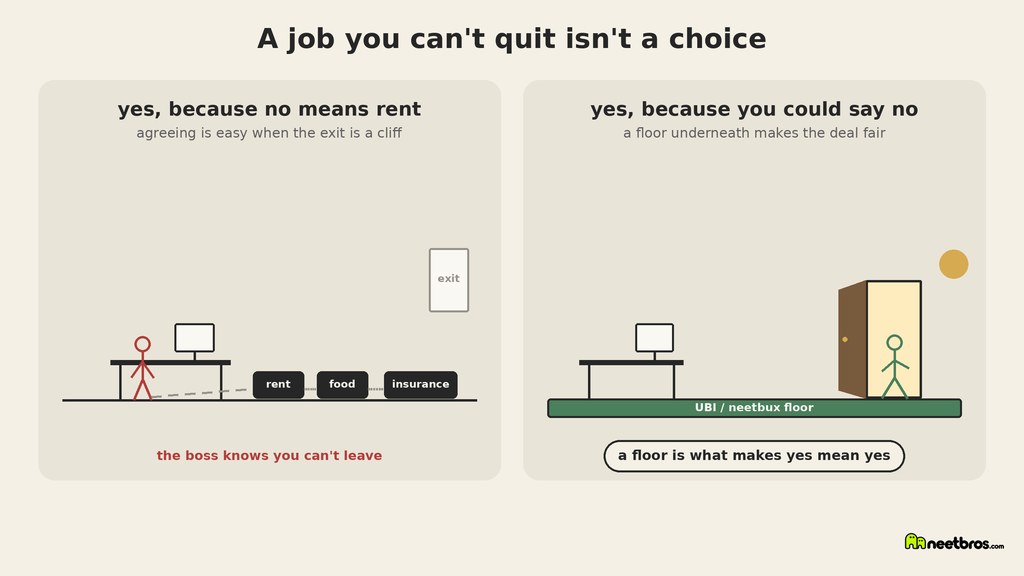
There is a line people use to end arguments about work. Nobody is forcing you. If you do not like the job, quit. If you do not like the pay, find another one. It is a free country and it is a free market. And on paper that is true. Nobody is going to drag you to the warehouse in handcuffs. But I keep thinking about what the word choice is supposed to mean. If one of the options is losing your apartment, going hungry and being called lazy by your own family, is the other option really something you chose? Or is it just the only door that was not on fire?
A real choice has at least two options you can live with. Tea or coffee. This apartment or that one. Take the offer or wait for a better one.
Most people facing a job offer do not have that. They have take it, or start falling. That is not nothing, but it is not a negotiation between equals either. One side can wait months for the right hire. The other side has rent due on the first.
We would never call a contract fair if one person signed it with someone standing on their oxygen line. We just do not notice the oxygen line when it is made of bills.
Job lock is the quiet part
Economists have a dry name for one version of this. Job lock. It is when people stay in a job they would otherwise leave, because leaving would cost them something they cannot risk, like health coverage, a pension, or a visa.
You probably know someone living it. They hate the work, they have a manager who treats them like furniture, they have wanted out for years. But the benefits are tied to the job, and starting over feels like jumping without a net, so they stay.
From the outside that looks like loyalty or stability. From the inside it feels a lot more like a hostage situation with a dental plan.
Bad jobs survive because people can't leave
Here is the part that does not get said enough. A lot of bad workplace behaviour exists because it works. The unpaid overtime, the surprise schedule changes, the manager who yells, the raise that never comes. Those things only keep going if the people on the receiving end cannot afford to walk.
If everyone had a floor to stand on, a terrible job would just stop getting applicants. It would have to pay more, treat people better, or close. That is how markets are supposed to work. The fear of having nothing quietly switches that off.
So when people say a basic income would make everyone stop working, I think what they often mean, without realizing it, is that it would make bad jobs stop working. That is not the same thing, and it is not a bad thing.
Sometimes being a NEET is the no
Not everyone out of work is out by choice. Plenty of people are sick, burned out, stuck in a town with nothing, or just unlucky. I am not trying to turn all of that into a heroic stand.
But some of us did look at what was on offer and say no. No to the job that broke your back for minimum wage. No to the third unpaid trial shift. No to the role that wanted you reachable at midnight. And we got treated like we had done something shameful.
I do not think refusing a bad deal is shameful. I think it is the one bit of leverage a person has, and we have built a system that punishes people for using it.
A floor makes every yes real
People with savings already live in the world I am describing. They can turn down a lowball offer, take a few months between jobs, leave a toxic boss without a plan. Nobody calls them lazy. We call it being careful with your career.
A basic income, UBI, neetbux, whatever we end up calling it, just hands a small version of that to everyone. Not luxury. Enough that no is a word you are allowed to say.
And here is the funny part. Once no is safe, yes means something. The people who stay in jobs would be there because the deal is decent, not because the alternative is the street. That is a better labour market for everybody, including the employers who are already treating people well.
Meanwhile
Until that floor exists, people scrape together whatever cushion they can, and if it helps a little, the AI you already pay for can claim paid micro-tasks for sats on neetbros.
And the next time someone tells you nobody is forcing you to work, it is fair to point out that a choice with only one survivable option is not much of a choice. It is just the shape of the cage.
Nobody tells a landlord to get a job is about who we expect to work and who we do not. Help shouldn't feel like a trial is about how welfare treats people who ask for it. The welfare cliff punishes anyone who tries is about losing support the moment you earn a little. Quiet quitting was just doing your job is about refusing to give away unpaid effort. Your job was never your community is about the social side of being tied to an employer.
 Freedom