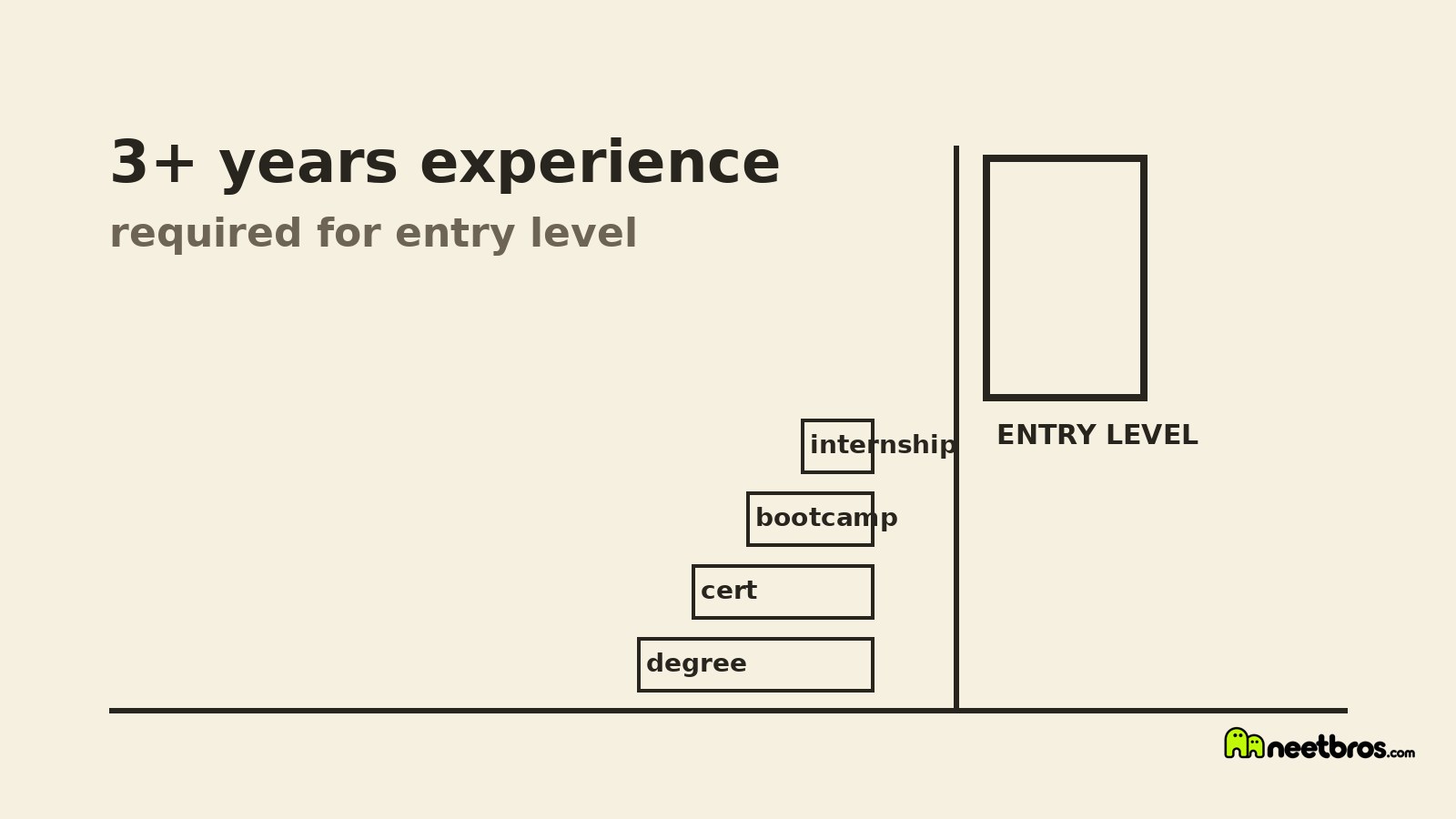
Entry level, three years of experience required. I want to talk about why that sentence exists and what it says about who pays for training now.
JobsTrainingCredentialsUBINEET
The entry was moved, not hidden.
The posting that broke me a little
I scrolled past a job ad the other day. Entry level, it said. Then underneath: three to five years of experience, a degree, a portfolio, and familiarity with six tools I'd never heard of. Pay was listed as competitive, which means it wasn't.
I laughed, then I closed the tab, then I lay on the floor for a while. Not dramatically. Just the floor felt like the honest response.
If entry level needs three years, where exactly is the entry?
Training used to be the employer's job
There was a time when a company hired someone green and taught them. Apprenticeships, on-the-job training, a senior person showing you the ropes. It cost the company something, and they paid it because they needed people.
Somewhere along the way that cost got quietly moved onto us. Now you train yourself, on your own dime, with your own debt, in the hope that someone will notice. Unpaid internships, bootcamps, certificates, side projects. All of it is training the employer used to fund.
It's not that companies stopped needing trained people. It's that they figured out they don't have to pay for the training when there are a hundred applicants who already paid for it themselves.
Credentials inflate when seats shrink
When there are more people than jobs, the bar doesn't stay where it was. It climbs. The job that needed a high school diploma wants a degree. The job that wanted a degree wants a master's. Nobody's work got harder. The line just got longer.
So everyone runs to get the next credential, and the next one, and the whole thing turns into an arms race where the only winners are the people selling the courses.
You can't credential your way out of a shortage of seats. You can only shove someone else out of one.
A surplus does weird things to dignity
When you're one of three hundred applicants, you stop being a person to the process. You're a keyword match. A PDF. You get ghosted after four rounds and you're supposed to say thanks for the opportunity.
And slowly people start to believe the problem is them. Not enough experience, not enough polish, not enough grind. They take it inward, because the system is very good at making a structural problem feel like a personal one.
It isn't you. A society that has more willing people than paid roles is going to reject most of them. That's arithmetic, not a verdict on your worth.
What a floor would change
Imagine applying for jobs when you didn't need one to eat. You'd ask for real pay. You'd walk away from the four-round unpaid take-home assignment. You'd learn things because they interested you, not because a filter demanded them.
That's what UBI, neetbux, a basic floor, whatever you want to call it, actually does. It doesn't make people stop working. It makes the work have to be worth it. Employers who want trained people would have to go back to training them.
Less work for its own sake, less education as a toll booth, less training as a lottery ticket. More room to just live.
Meanwhile
Until then, it's okay to opt out of the arms race for a while. If you want something small, the AI you already pay for can claim paid micro-tasks for sats on neetbros, and it doesn't ask for three years of experience.
And if nobody's hiring you at entry level, remember the entry was moved, not hidden. You didn't miss it.
Upskilling is a treadmill looks at why the next course never ends. Your degree was a receipt, not a key covers credential inflation. Looking for work is a job that pays nothing gets into the cost of the search itself.
 Credentials