 Free time
Not every hobby has to be a side hustle
A few months ago I got really into baking bread. Nothing fancy. A sourdough starter on the counter, a lot of flat loaves at first, then slowly some good ones. It was the most relaxed I'd felt in a long time. Mixing, waiting, folding, waiting. My hands were busy and my head was quiet.
Then I posted a picture of a loaf and the first three replies were some version of the same thing. You should sell these. Have you thought about a farmers market? Start a page, people would pay for this.
Everyone meant it kindly. But I noticed something in my chest tighten when I read them, like the bread had stopped being mine. That's what this post is about. Somewhere along the way we started treating every hobby as an unlaunched business, and I don't think that's good for us.
Every hobby is a pitch now
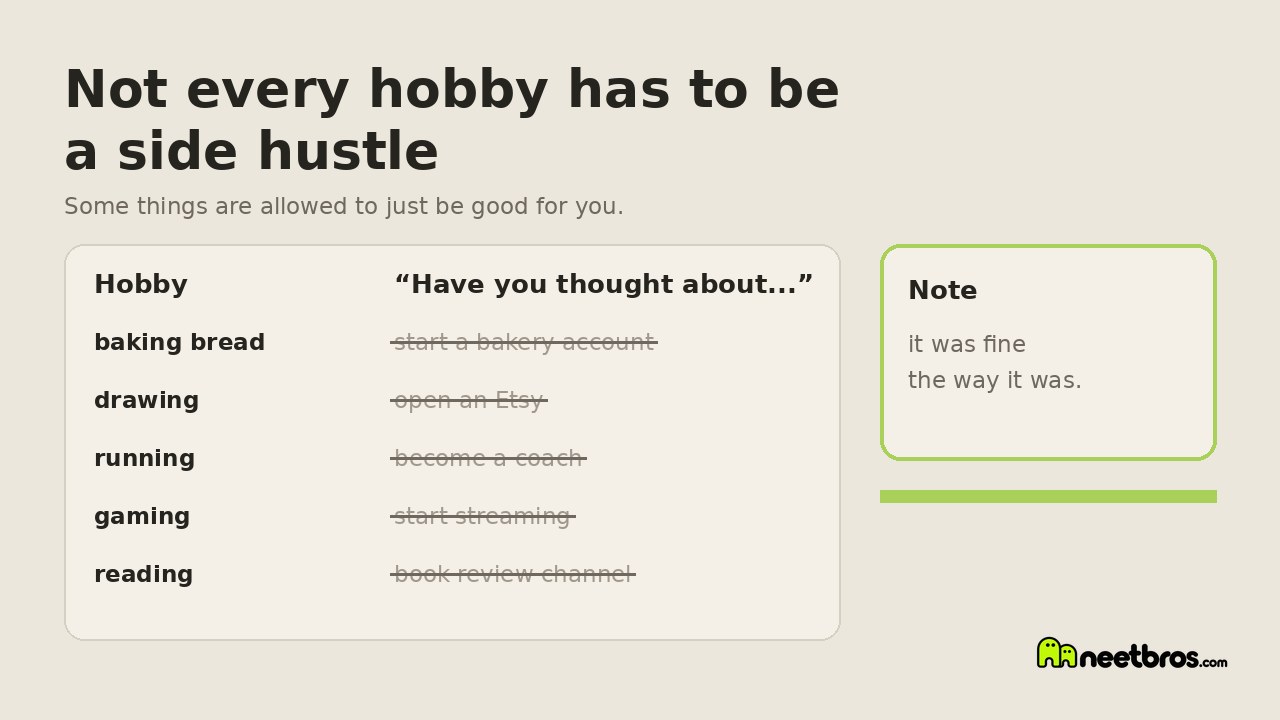
You draw, so open an Etsy. You run, so get certified and coach. You play games, so stream. You read a lot, so start a book channel. You knit, sell patterns. You like plants, start a plant account. There's a monetized version of almost anything a person can enjoy, and somebody will point it out within a week of you mentioning it.
It's usually well-intentioned. People are worried about money, theirs and yours, and suggesting a side hustle feels like support. In an economy where so many people are one bad month from trouble, turning your free time into income sounds responsible.
But it also means there's almost no part of life left that's just allowed to be for you.
What happens when you monetize it
I've watched friends do it. One started selling her illustrations. Within a year she was drawing what sold instead of what she liked, answering customer messages at midnight, worrying about the algorithm, and pricing her own hours against the minimum wage. She doesn't draw for fun anymore. She says it feels like opening her work laptop.
That's not a story about her failing. Some people genuinely love turning a hobby into a business, and good for them. It's a story about what money does to an activity. The moment it has to pay, it needs metrics, customers, consistency, and growth. The quiet part goes away first.
There's a reason rest and play feel different from work. It isn't the activity. It's whether anyone is depending on the output.
Free time became a resource to optimize
I think the side hustle push is a symptom of something bigger. We've come to see unstructured time as wasted time. If you're not earning, you should be learning. If you're not learning, you should be networking. If you're just enjoying something, the question is why you haven't figured out how to make it productive yet.
For people without a job, it's even louder. A NEET who bakes bread isn't seen as someone with a nice hobby. They're seen as someone sitting on an unrealized business plan. Every interest becomes evidence for or against whether you're trying hard enough.
I don't think this comes from greed. I think it comes from fear. When there's no floor under you, every spare hour looks like something you should be converting into security.
Hobbies are where people actually recover
The stuff people do for no reason is often what holds them together. Gardening, fixing old bikes, painting miniatures, learning an instrument badly, walking the same trail every morning. These aren't distractions from real life. For a lot of people, they are the real life, and the job or the job search is the distraction.
Hobbies are also where a lot of good things quietly come from. Open source software, local history projects, community gardens, mods for old games, recipes passed around, the neighbour who fixes everyone's computer. Nobody planned these as businesses. They happened because someone had time and liked doing it.
When every hobby has to justify itself as income, we lose a lot of that. Not because people stop caring, but because they're too tired and too anxious to do anything that doesn't pay.
A floor would let hobbies be hobbies
This is where I always end up. With a basic floor under everyone, UBI, neetbux, whatever name you like, the pressure to turn every interest into a revenue stream drops a lot. You could bake bread just because it's nice. You could give the loaves away. You could get good at something slowly, without a business plan attached.
People who want to sell their bread could still sell it, and they'd probably do it better because they chose to, not because they were scared. That's not anti-business. It's just a calmer starting line for everybody.
Less work squeezed into every corner of the day. Less training disguised as leisure. Less hustle as the default answer to how are you doing for money. More time that belongs to nobody but you.
If someone tells you to sell it
You can just say thanks, I'm keeping this one for me. That's a complete answer. You don't owe anyone a business case for the thing that makes you feel human.
If you need a little income, it doesn't have to come out of your hobby. The AI you already pay for can claim paid micro-tasks for sats on neetbros, and your bread stays bread.
And if you're someone who's been feeling guilty for enjoying something that doesn't pay, maybe let yourself off the hook today. It was fine the way it was.
Hustle is a product, not a path looks at who profits from grind culture. Rest is not something you earn asks why stopping feels like a crime. The most useful people I know don't have jobs covers the unpaid work that holds communities together.