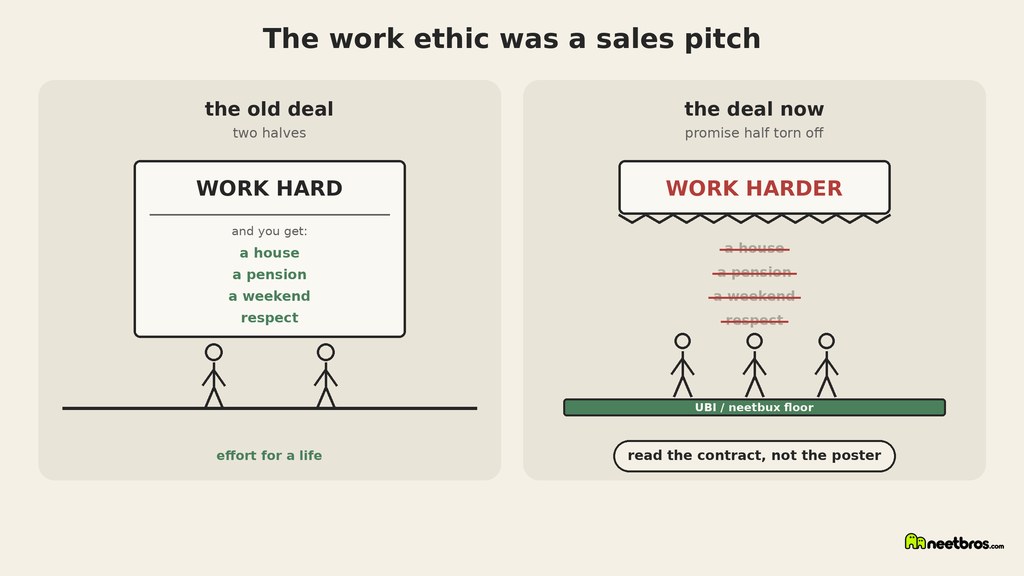
Every time I say out loud that I'd like to work less, someone reaches for the same phrase. Work ethic. As if it were a natural law, like gravity, and I'd been caught trying to float. I used to feel that one in my chest. Now I mostly hear it as what it is: a story. A useful one, for some people. An old one. But a story, not a law of nature. Somewhere along the way the work ethic stopped being a description of how people lived and became a sales pitch for a deal that keeps getting worse, and I think a lot of NEETs are just the first people to stop buying.
Work ethicEmploymentEffortDignityHustleCredentialsUBINEET
The work ethic was a sales pitch
A virtue that showed up right on time
If you read even a little history, the timing of the work ethic gets suspicious. Long hours, punctuality, and the idea that idleness is a sin got preached hardest exactly when factories and offices needed lots of people to show up on schedule and stay put. Max Weber wrote a whole famous book about how religious ideas about work and worth lined up neatly with the rise of capitalism. You don't have to agree with every page to notice the shape of it.
That doesn't mean the people who believed it were fools. Plenty of them were trying to survive and find meaning in hard lives. But a virtue that conveniently appears when an economy needs disciplined labour, and gets taught in schools, sermons and posters, is at least worth a second look. Who benefits when you feel guilty for resting?
Most moral ideas that tell you to give more of your time to someone else, for less, deserve the same question.
The deal used to have two sides
Here's the part that gets left out of the lecture. The old version of the work ethic came with a promise attached. Work hard and you get a stable job, a house, a pension, a weekend, some respect in your town. The ethic was one half of a trade.
The trade quietly fell apart. Wages flattened while costs went up. Pensions became gambles. Contracts got shorter. Entry level started wanting experience. Degrees turned into debt. The promise half of the deal got renegotiated without anyone asking us, but the ethic half stayed exactly as loud. Maybe louder.
So now people are asked to keep the vow after the other party left the marriage. Work hard, for what? Rent that eats half your pay? A job that might be gone next quarter? When I hesitate, it isn't because I have no ethic. It's because I read the contract.
Work ethic as a way to sort people
In practice the phrase mostly gets used as a sorting tool. People with jobs are assumed to have it. People without jobs are assumed to lack it. It doesn't matter if the person without a job is caring for a parent, recovering from burnout, living somewhere with no openings, or just got cut in a round of layoffs that had nothing to do with them.
That's what makes it slippery. It's never measured. It's inferred from your employment status and then used to explain your employment status. Unemployed? Must be the ethic. Employed in a terrible job? Good ethic, keep going. It's a circle that always ends with the individual being the problem.
And it's weirdly selective. Nobody asks whether someone who inherited a fortune has a work ethic. Nobody lectures shareholders about getting up early. The ethic is mostly aimed down, at people who have the least to gain from it.
Effort is not the same as value
The deepest trick, I think, is the merging of effort and value. The work ethic says hard work is good in itself, not just when it produces something people need. That's how we end up with busywork, performative overtime, and jobs that exist mostly to look like jobs.
If a machine can do a task in ten minutes and a person is told to stretch it to a full shift because that's what good workers do, that's not virtue. That's waste with a halo. A society that had really internalised value over effort would celebrate every hour it no longer needs from people.
Instead we treat freed-up hours as a moral emergency. Every efficiency becomes a reason to find people new hoops, new training, new credentials, rather than a reason to let them go home.
Some of us just stopped believing it
I don't think NEETs, quiet quitters and people opting out of the grind are lazier than earlier generations. I think a lot of us just did the maths earlier. We watched our parents give everything to employers that didn't give it back. We watched the goalposts move every few years. We noticed that the people preaching hardest were often the ones who needed us to work, not the ones doing it.
Stopping believing isn't the same as stopping caring. Most people I know outside paid work still do things. They look after family, fix stuff for neighbours, learn things for fun, make art nobody pays for, keep online communities alive. They just stopped pretending that a wage is the only proof of a decent person.
Bertrand Russell wrote an essay ages ago called In Praise of Idleness, arguing that the belief in work as a virtue causes a lot of harm and that shorter hours would make people kinder and happier. It reads less like a joke every year.
What a floor does to the story
This is where UBI, or neetbux, or whatever name ends up sticking, matters to me. A basic income floor doesn't abolish effort. It changes what effort is for. If your rent and food are covered, work becomes something you do because it's useful, interesting, or pays enough to be worth it, not a loyalty test you take to avoid going under.
It also takes the teeth out of the sales pitch. You can't shame people into bad deals as easily when they have a floor. Employers have to offer something real. Education can go back to being about curiosity instead of a credential arms race. Training can be chosen instead of imposed.
And honestly, it would let a lot of people be gentler with themselves. You could take a year to recover, care for someone, or just think, without the background hum of the work ethic telling you you're failing a test nobody else is grading fairly.
Meanwhile
Until there's a real floor, people stitch things together however they can, and if it helps, the AI you already pay for can claim paid micro-tasks for sats on neetbros.
But mostly I'd say this. If the phrase work ethic makes you feel small, it's okay to ask who wrote it and what they were selling. Not wanting to give your whole life to a deal that stopped paying out isn't a character flaw. It's reading the fine print.
Being busy is not a personality is about mistaking motion for worth. Rest is not something you earn pushes back on the idea that downtime has to be paid for in advance. Idle hands are not the devil's workshop looks at another old moral line about free time. Less work is the point of progress asks where all the productivity gains went. We produce enough. We ration dignity. is about the gap between abundance and the floor.
 Work ethic