 Policy
Full employment is a weird goal for a rich country
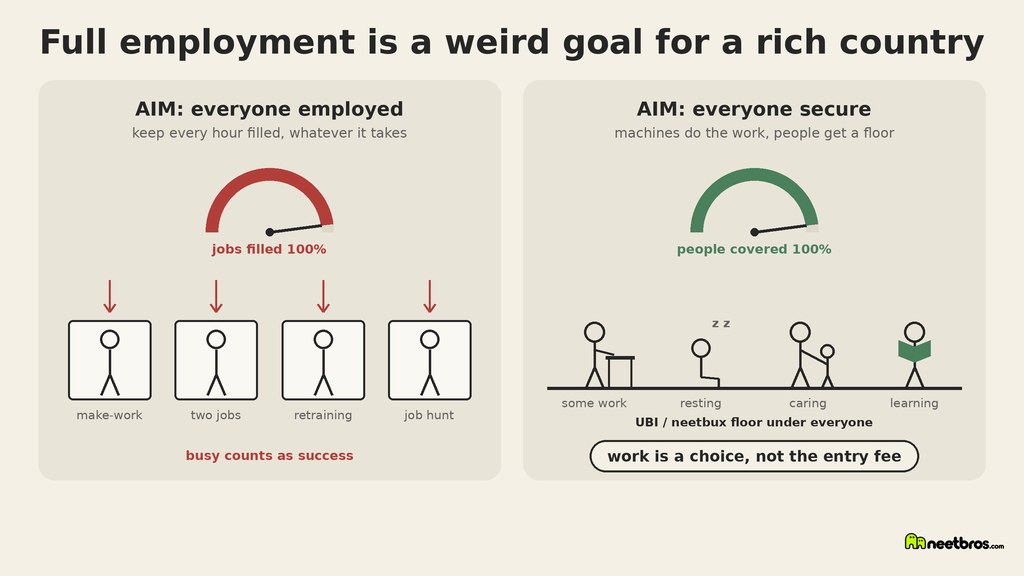
Every time the jobs numbers come out, the news reads them like a report card for the whole country. Unemployment down, good. Unemployment up, bad. Politicians from every side promise to get it lower, and the dream number everyone quietly aims for is basically everybody who can work, working. I used to nod along to that without thinking. It sounds so obviously decent. Who's against people having jobs? But the longer I've been on the outside of the job market, the stranger the goal looks to me. We live in one of the richest, most productive societies that has ever existed, with machines that do in an afternoon what used to take a town a year, and our big collective ambition is to make sure everybody stays busy. I don't think that's the right target anymore. I think we kept the scoreboard after the game changed.
Where the goal came from
Full employment made a lot of sense once. If most of the stuff a society needs has to be made by human hands, then the more hands working, the more stuff, and the better off everyone is. A job was also the main pipe money flowed through to reach ordinary households. No job, no income, no food. So keeping people employed was a pretty direct way of keeping people alive.
It also made sense politically after some very bad decades where lots of people were out of work at once and things got ugly. Governments learned that mass unemployment was dangerous, and full employment became a kind of promise. We won't leave you stranded like that again.
I respect that history. The problem is that the reasons behind the goal have been slowly dissolving, and the goal itself hasn't moved an inch.
A productive economy needs fewer hands
The whole point of better tools is that you need fewer people to get the same result. That's what productivity is. So in an economy that keeps getting more productive, the number of genuinely necessary jobs is always under pressure, while the number of people who need an income keeps growing with the population.
That gap is surplus labour. It's not a moral failing of the people in it. It's arithmetic. When a warehouse automates, when a bank closes branches because everyone uses the app, when software replaces a back office, the economy gets a little better at producing stuff and a little worse at needing people.
If you insist on full employment anyway, you're committing to fighting that arithmetic forever. Every efficiency gain becomes a new problem to solve, a new group of people to find something for. That's a weird thing to be doing on purpose.
Chasing the number means inventing work
So how do you keep everyone employed when you don't need everyone? Mostly by inventing things for them to do. Extra layers of management. Paperwork that exists to check other paperwork. Jobs whose main output is reports about other jobs. Roles nobody in them can fully explain at a party.
I don't say that to mock anyone in those jobs. People need rent money and they take what's offered. But if a meaningful slice of employment is just keeping busy, then we're already paying people to exist. We're just making them commute, dress up and act stressed to earn it.
That's the hidden cost of the full employment target. It doesn't just measure work. It creates pressure to manufacture it, because an empty seat looks like failure on the scoreboard.
The scoreboard can't see burnout
Another weird thing about the employment rate is what it counts as a win. Someone working two part-time jobs with no benefits counts the same as someone with one stable job. Someone burning out at sixty hours a week counts the same as someone comfortable at thirty. A gig worker who made forty dollars this week is employed. A person caring full-time for a dying parent is not.
So the number can go up while people's lives get worse. It doesn't care whether the work is good, whether it pays enough, or whether anyone's actually okay. It just cares that the hours are filled.
That's why I think it's a bad compass. A country can hit amazing employment numbers while a lot of people in it are exhausted, scared and one bad month away from losing their place.
Hustle and credentials are how we keep the number up
When there aren't enough real jobs, the pressure goes onto individuals. Get another certificate. Retrain into whatever's hot this year. Start a side business. Build a personal brand. Network until you squeeze into something. All of that keeps people in motion, and motion keeps the numbers looking healthy.
But more training doesn't create more seats. It just makes the line for the same seats longer and more expensive. And hustle doesn't change how many people the economy needs. It just shuffles who gets the scraps and makes everyone else feel like it's their fault.
That's why I've come around to wanting less of it. Less required education, less required training, less required hustle. Learn things because they're interesting or useful to you, not because you need a fourth credential to be allowed to keep living indoors.
Dignity shouldn't ride on a percentage
The quietest damage the full employment goal does is to how people see each other. If the national mission is for everyone to have a job, then anyone without one becomes a small failure of that mission. A statistic to be fixed. Someone to be activated, motivated, retrained, monitored.
I know how that feels from the inside. You start to experience yourself as a problem in somebody's spreadsheet. Every benefits form, every awkward family dinner, every news segment about the labour market lands like a reminder that you're the bad number.
But a person is not a decimal point in an employment rate. The people I know without jobs are raising kids, looking after relatives, fixing things for neighbours, making music, volunteering, or just trying to recover from years of grinding. They're not missing from society. They're just missing from one particular count.
A better target: everyone secure
So what would a better goal look like? I think it's something like full security instead of full employment. Instead of asking how many people have jobs, ask how many people have a stable floor under them. Enough to cover housing, food and basics, whether or not anyone currently needs their labour.
That's where UBI, neetbux, or whatever name sticks comes in. If everyone gets a basic income, the job stops being the only pipe money flows through. Then a productive economy can actually enjoy being productive. Machines do more of the work, fewer hours are needed, and instead of that being a crisis, it's just people getting their time back.
On that scoreboard, the person caring for their mom counts as fine. The person working twenty hours because that's what they want counts as fine. The person taking a year off to recover counts as fine. The goal becomes nobody falling through, not everybody staying busy.
Less work, less forced employment
None of this means nobody would work. Plenty of people like their jobs, like the structure, like being part of a team, or want extra money on top of the floor. Those people would keep working, probably with a lot more bargaining power, because walking away wouldn't mean ruin.
What would shrink is the forced part. The working because you're terrified. The training because you're told you're unemployable otherwise. The hustling because the alternative is shame. Less of that is not a collapse of society. It's what a rich society should be able to afford.
Honestly, it might even make the work that's left better. When people aren't trapped, bosses have to treat them like adults. Jobs that are pure busywork get harder to fill. The economy starts to reflect what actually needs doing, not what keeps the number up.
Meanwhile
Until anything like that floor exists, most of us are patching things together however we can, and if a small trickle helps, the AI you already pay for can claim paid micro-tasks for sats on neetbros.
But mostly I want to say this to anyone who feels like they're dragging down the stats. You're not the problem the number is trying to fix. The number is just aimed at the wrong thing. A rich country shouldn't be measuring how busy its people are. It should be measuring whether they're okay.
Half the jobs out there are fake is about the busywork we already pay for. Less work is the point of progress is about where the gains from better machines were supposed to go. The job market is musical chairs is about why there were never enough seats to begin with.