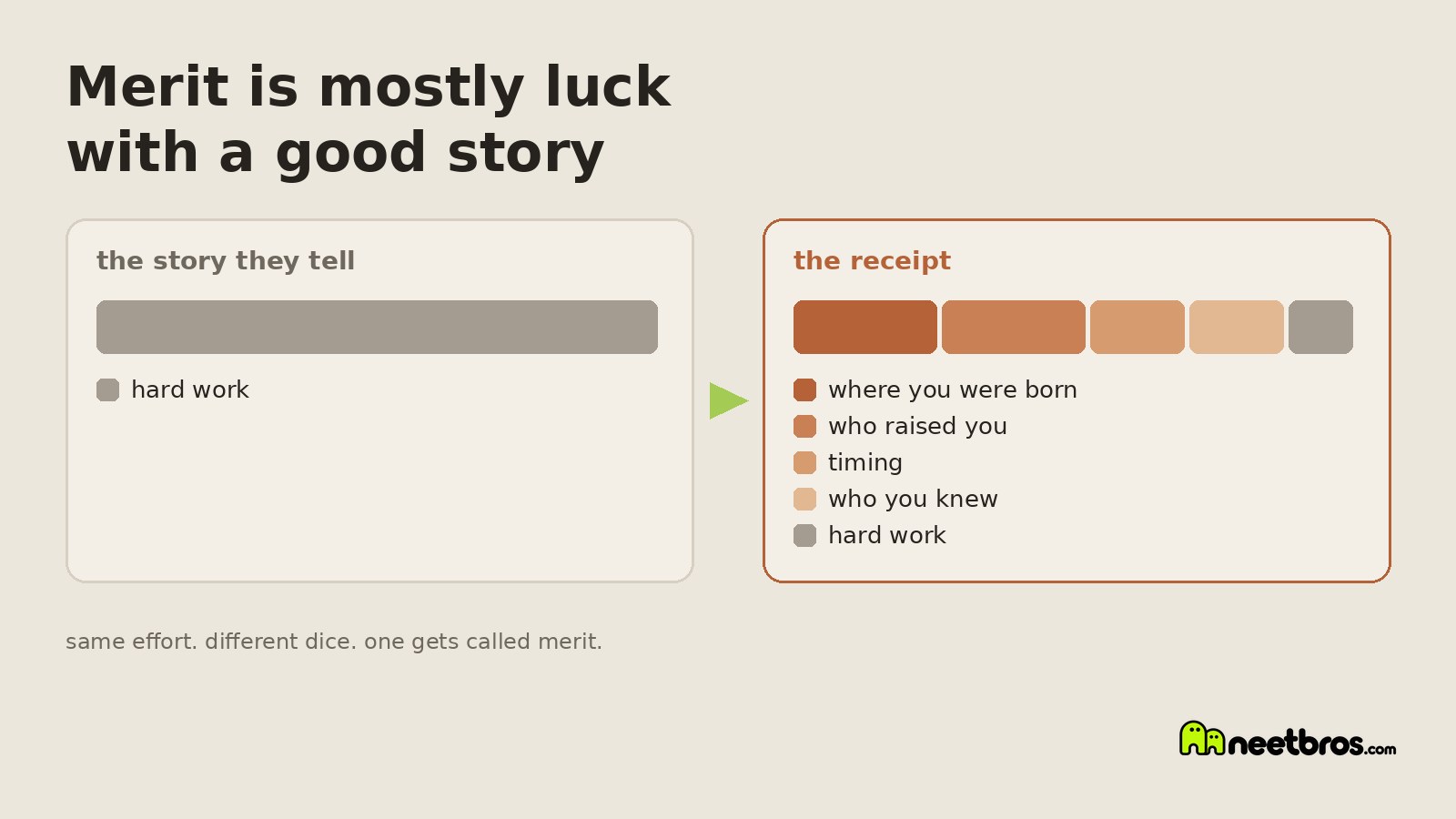
Nobody picks their parents, their postcode, or the year they graduate into. Then we hand out jobs and shame as if they did. I want to talk about meritocracy, not as a conspiracy, just as a story that got too comfortable.
Success stories get written after the fact. Someone lands the seat, then looks back and picks out the parts that felt like effort. The early mornings. The grind. The one brave email.
What doesn't make the speech is the stuff that was handed over before they could walk. A quiet room to study in. A parent who knew what an internship was. A city where the jobs actually were. A recession that hit two years after them instead of during.
Effort is real. It's just one bar in a longer receipt, and it's the only one people like to read out loud.
Effort is everywhere, seats aren't
Here's the part that bugs me. Most people already try hard. The cashier tries hard. The person on their fortieth application tries hard. The guy doing two gigs and a night course tries hard.
If effort reliably turned into a decent living, we'd see it. Instead we see more effort chasing the same number of good seats. When everyone runs faster, the race doesn't get more places. It just gets more tired.
So the honest version of merit is something like this: among people who were already lucky enough to be near the door, the hardest workers sometimes get through.
Why the winners need it to be true
Believing you earned everything feels good. It also makes it easy to look at someone without a job and decide they must have earned that too.
That's where meritocracy stops being a nice idea and starts being a moral sorting machine. If the system is fair, then the people at the bottom are there for a reason, and the reason is them. No policy needed. Just more advice.
Luck is humbling. Merit is flattering. Guess which one gets taught in school.
Credentials are luck you can frame
Degrees, certificates, the right internship on the CV. A lot of it looks like proof of ability, and some of it is. But a lot of it is proof that you could afford to spend years not earning while you collected paper.
Then the paper gets used to filter people who couldn't. And the filter gets called merit, because it sounds better than saying we picked the ones who started closer.
When there are more qualified people than good jobs, the bar doesn't measure talent anymore. It measures who could wait the longest.
Surplus people aren't failed people
The economy keeps making more with fewer hours. That's not a secret, it's the whole point of machines and software. It means there will be people the labour market just doesn't need, no matter how many workshops they sit through.
Calling those people lazy is the meritocracy story doing cleanup. It turns a numbers problem into a personal flaw, so nobody has to talk about the numbers.
Being surplus to a hiring process is not the same as being surplus to the world. You can still be kind, curious, useful to your friends, and good at things nobody pays for.
A floor admits the dice are real
This is why I keep coming back to UBI, or neetbux, or whatever name sticks. A basic floor is just an honest admission that a lot of outcomes are luck, so nobody should fall all the way through because of a bad roll.
It doesn't stop anyone from working hard. It just means hard work stops being the entry fee for staying alive. You can still chase the big seat. You just don't have to pretend the people who miss it deserved to drown.
Less work as a loyalty test. Less education as a waiting room. Less training as penance. More dignity that doesn't come with an application form.
Meanwhile
If you're at home and the story says that's your fault, try reading the receipt instead. Most of it was rolled before you showed up. And if you want a little trickle coming in while the bigger stuff gets argued about, the AI you already pay for can claim paid micro-tasks for sats on neetbros.
You're not behind in a fair race. You're in a lottery that likes to call itself a ladder.
Your degree was a receipt not a key is about credentials that don't open doors. Your parents' advice was for a different economy covers the timing part of the dice. They call it a skills gap so wages stay put is what the story sounds like from the employer side.
 Dignity