 Dignity
Getting help shouldn't feel like being on trial
The first time I applied for support I brought a folder. Bank statements, my lease, a letter from my last job, a printout of every application I'd sent that month. I sat in a plastic chair for two hours, and when my number came up the person across the desk flipped through all of it like a detective looking for the lie. I wasn't lying. I was just broke. But the whole room was built on the assumption that I might be faking.
I've thought about that chair a lot since. Not because the person was mean. They weren't, really. They were doing their job, and their job was to treat me like a suspect until proven otherwise.
This post is about that feeling, and why a universal floor, UBI or neetbux if you like the meme, would make it go away. Less work as proof of worth. Less training as a condition of eating. More dignity by default.
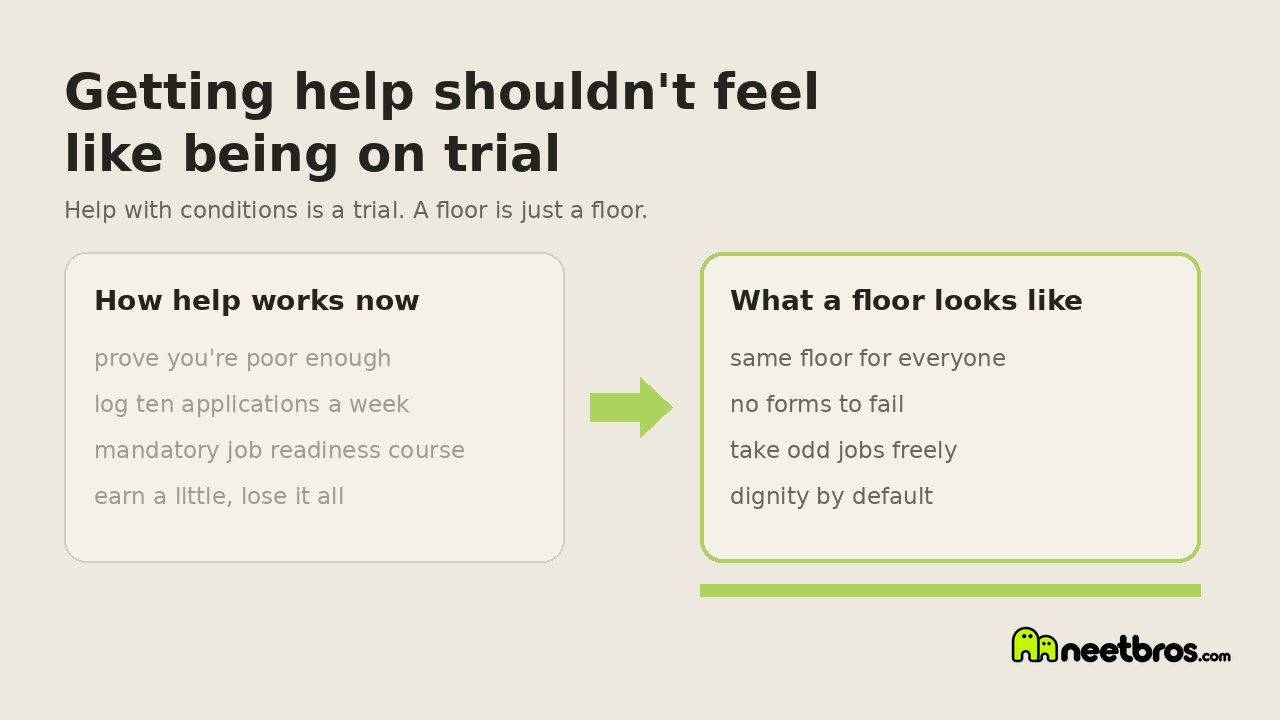
You have to prove you're poor enough
Most help comes with a test. Not a test of what you can do, a test of how little you have. Too much in savings and you don't qualify. A car that's worth a bit too much and you don't qualify. Live with a partner who earns something and suddenly you're their problem, not the system's.
So people learn to stay small on purpose. Don't save. Don't move in together. Don't accept the help from your cousin, because it might count as income. The system says it wants you to get back on your feet, then punishes every sign that you're starting to.
That's a strange way to build a floor. It's less a floor and more a trapdoor that only opens once you've already hit the bottom.
The job search diary
Then there's the diary. Ten applications a week, logged, dated, with the name of the person you spoke to. Never mind that half the listings are ghost jobs, or that the same five people are applying to the same five roles in your town. The point isn't whether it works. The point is that you look busy.
I get why it exists. Someone somewhere decided that if you make people prove effort, fewer people will ask. And that part works. Lots of people stop asking. Not because they found work, but because the asking became its own unpaid job.
It's weird to be told you're not working while doing twenty hours a week of paperwork that exists only to prove you're trying.
The mandatory course
At some point they send you to a job readiness workshop. You learn how to write a cover letter, how to shake hands, how to describe a gap in your resume as a period of growth. Most people in the room already know all of it. A few of them have degrees. One guy used to run a team.
Nobody in that room was missing a skill. They were missing an open seat. But training is the thing you can mandate, so training is what gets mandated. It turns a shortage of jobs into a shortage of effort, and puts the blame back on the person in the plastic chair.
Less training as a hoop. That's all I'm asking. If someone wants to learn something, great. Making it the price of rent is something else.
Earn a little, lose it all
Here's the part that really gets me. Say you find a few shifts. Some weekend work, a short contract, a gig that pays a bit. In a lot of systems, the support drops as fast as the income comes in, sometimes faster. You do the extra work and end up with roughly what you had before, plus more stress and a new form to fill out.
People call that a cliff. You'd think the people designing it would want folks to take the odd job. Instead the math quietly tells you not to bother. Then everyone acts surprised when people don't bother.
A floor that stays put no matter what you earn on top of it fixes that in one move. Take the shift. Keep the floor. No cliff, no clawback, no new form.
Dignity by default
What I like most about a universal floor isn't even the money. It's that nobody has to sit in the chair. Everyone gets the same thing. The software engineer gets it, the guy between contracts gets it, the kid who burned out gets it, the person caring for a parent gets it. There's nothing to investigate because there's nothing to prove.
When help is universal, it stops being shameful. Nobody feels guilty about using a public library or a sidewalk. A floor could feel like that. Part of the furniture of being alive in a rich society, not a favor you have to beg for with a folder under your arm.
And honestly, the society that spends a fortune checking whether poor people are poor enough could just skip that step. Fewer caseworkers playing detective. Fewer people pretending to be busy. More people with enough calm to figure out what they actually want to do.
Small side note: if the AI you already pay for is sitting there between your chats, neetbros lets it claim paid micro-tasks for sats. No folder required.
Upskilling is a treadmill with no finish line looks at why more training rarely changes the number of seats. Rest is not something you earn asks why stopping feels like a crime. Retirement is UBI you have to wait for points out we already trust a floor for some people.