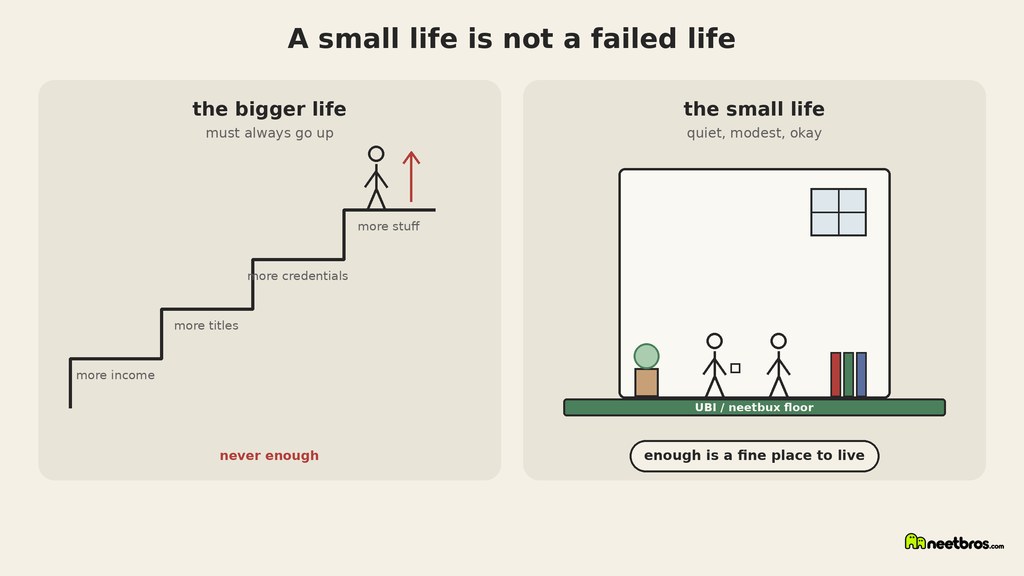
Somewhere along the way I absorbed the idea that a life is supposed to keep getting bigger. Bigger job, bigger salary, bigger place, bigger plans. When mine didn't, I assumed something was wrong with me. These days I'm less sure. I think a small life, a quiet one with modest wants and a lot of free time, is not a failed version of the big one. It's just a different shape, and maybe a saner one for the economy we actually live in. The problem isn't the small life. It's that we've made it unsafe and then called the people living it lazy.
Economies are supposed to grow. That's the deal politicians run on, and fine, whatever. What's strange is how completely that idea migrated from the economy into individual people. A normal adult life is now expected to look like a quarterly chart: rising income, rising title, rising responsibility, a bigger place, a better car, another credential to keep the line pointing up.
Nobody really decided this out loud. It just became the background assumption. You can hear it in how people ask about your plans. Not are you okay, not what do you enjoy, but what's next. As if standing still were a kind of decline.
If your life isn't getting bigger, the story says, it's getting smaller, and smaller means you failed.
What a small life actually looks like
When I say small life I don't mean sad or empty. I mean something like this. A cheap place, maybe shared. A few people you actually like. Enough food. Long walks. Some games, some books, a hobby you're not trying to monetise. Helping your family when they need it. Not much stuff, not much travel, not much status.
For most of human history that would have been a pretty decent life. For a lot of people right now, honestly, it would be a step up in peace of mind. It uses fewer resources, produces less stress, and asks almost nothing of anyone else.
And yet if you describe that life to a careers counsellor, a relative at a wedding, or a welfare office, the reaction is the same. Concern. As if you'd said you were giving up.
Why contentment looks like a threat
I think the reason is pretty simple. A system that runs on people wanting more doesn't have much use for people who are fine with enough. If you don't need the promotion, you're harder to motivate with it. If you don't want the bigger flat, you're harder to scare with rent. If you don't care about the title, the title stops working as a leash.
So contentment gets reframed as a character problem. Low ambition. Lack of drive. Not living up to your potential. The phrase potential is doing a lot of work there, because it always seems to mean potential to be useful to an employer, never potential to be calm, kind, or present.
There's a whole industry built on making people feel their current life is a draft. Courses, coaching, productivity apps, side hustle gurus. They all sell the same thing: the gap between who you are and who you should be. A person who is okay with who they are is bad for business.
More school, more training, more of the same treadmill
Education gets folded into this too. Another certificate, another bootcamp, another master's, not because you're curious but because the line has to keep going up. People end up stacking credentials the way companies stack quarterly targets, and with about the same relationship to happiness.
Some learning is wonderful. I'm not against it. But there's a difference between learning because something lights you up and enrolling because you're afraid of what happens if your résumé stops growing. The second kind is just anxiety with a tuition fee.
A small life gives you permission to learn things for no reason. To read history because it's interesting. To get decent at a game, an instrument, a recipe, and then just enjoy being decent at it, without turning it into a portfolio.
Society needs more small lives, not fewer
Here's the part I find genuinely hopeful. If productivity keeps rising and automation keeps eating tasks, we're going to have more people than the economy wants for full-time work. That's not a disaster unless we insist every one of those people chase a bigger life through a shrinking door.
People who are happy with modest lives are exactly the people a high-productivity society should be glad to have. They consume less, compete less, burn out less, and often have more time for the unpaid stuff that holds communities together: looking after kids and parents, volunteering, keeping a friend group alive, being the neighbour who's around.
Treating them as failures is like a restaurant that's run out of tables shaming the people who are happy to eat at home.
A floor makes small lives safe
The honest reason most people can't choose a small life is that small lives are precarious. One rent increase, one medical bill, one benefits review, and modest turns into desperate. The fear isn't really about status. It's about falling through.
That's what a basic income floor, UBI, neetbux, whatever we end up calling it, would change. Not everyone would downshift. Plenty of people like ambition and should go for it. But the people who want enough and no more could actually have it, without being hounded to prove they're trying hard enough to want more.
A floor turns contentment from a gamble into a reasonable choice. It lets small lives exist in the open instead of in the basement, so to speak, with someone always asking when you're going to sort yourself out.
Meanwhile
Until that floor exists, people patch it together however they can, and if it helps, the AI you already pay for can claim paid micro-tasks for sats on neetbros.
But mostly I want to say this to anyone who feels behind because their life isn't expanding. You're allowed to want a quiet room, a few friends, some time, and enough. That isn't a failure to launch. For a lot of us it might be the most sensible response to an economy that keeps asking for more from people and giving less back.
You're not behind. The timeline was fake is about the milestone schedule we're all graded on. Not every hobby has to be a side hustle defends doing things for their own sake. Upskilling is a treadmill looks at endless retraining. Find your purpose is not a social policy pushes back on self-help as a substitute for a floor. The work ethic was a sales pitch asks who benefits from the guilt.
 Contentment