If the machines do the work, who gets the money the work used to earn? I want to sit with that question for a bit.
AutomationProductivityReskillingUBINEET
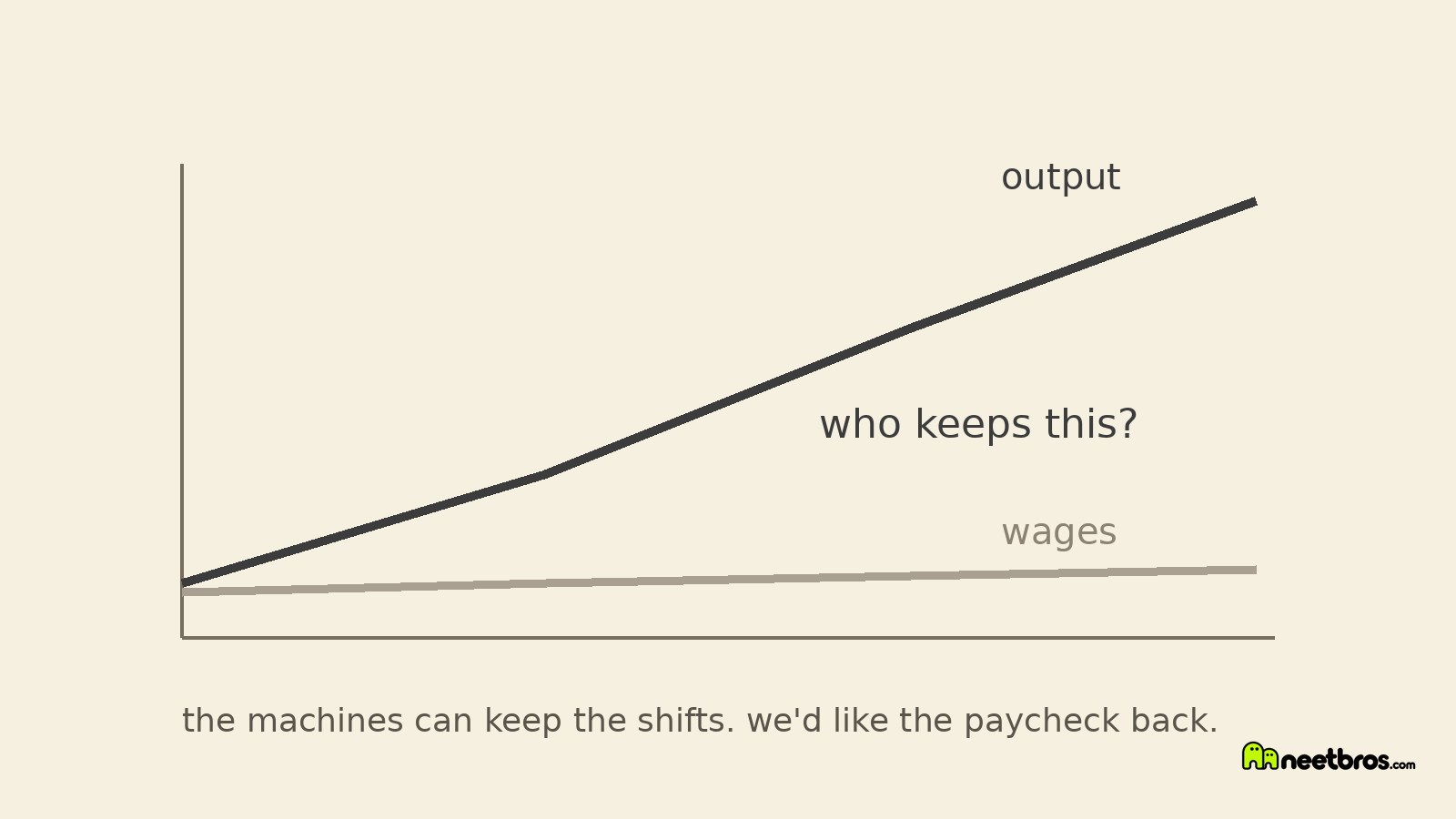
The machines can keep the shifts. We'd like the paycheck back.
The question nobody answers
Every few months there's a new headline about machines taking jobs. Warehouses, call centers, now writing and coding and design. The articles always end the same way. Workers will need to adapt.
I keep waiting for the other half of the sentence. If the machines do the work, who gets the money the work used to earn? The headline never says. It just moves on to the next funding round.
I think that silence is the whole story.
Productivity went up, the paycheck didn't
For decades output per worker has climbed while wages for most people barely moved. The gap didn't vanish. It went somewhere. Mostly to whoever owns the machines, the software, the buildings.
That isn't a conspiracy. It's just how ownership works. If you own the tool, you keep what the tool makes. If you only own your hours, you get paid for hours, and the tool is busy making your hours worth less.
So when people say automation will free us, I want to ask: free who, and to do what, with what rent money?
Retrain is a polite way of saying good luck
The official answer is reskilling. Learn the new thing. Get the new certificate. Then the new thing gets automated too and you're back at the start, older and with more student debt.
Training isn't bad. But it's being asked to carry a load it can't carry. You can't course your way out of a world that needs fewer workers. Everyone retraining for the same shrinking pile of jobs just makes the line longer.
At some point we have to admit that the problem isn't that people lack skills. It's that we tied survival to a thing we're actively making less necessary.
Surplus people aren't a mistake
There's a quiet way society treats people who don't fit into the shrinking job market. Lazy. Unmotivated. A drain. As if the economy had a seat for everyone and you just didn't sit down.
But surplus labor is a design outcome, not a personal flaw. When a machine replaces ten people, nine of them become surplus by definition. Blaming those nine for not hustling hard enough is like blaming chairs for the music stopping.
Dignity shouldn't depend on whether your job survived the latest upgrade.
A floor is just a share of the output
This is where UBI, neetbux, whatever you call it, stops sounding radical. If the machines are built on decades of public research, public infrastructure, and the work of everyone who came before, then some of what they produce belongs to all of us.
A basic floor isn't charity. It's a dividend on a society that got very good at making stuff with fewer hands. Less work, less pointless training, less pretending, and enough to live while you figure out what you actually want to do with your time.
The machines can keep the shifts. We'd just like the paycheck back.
Meanwhile
Until that floor exists, it's fine to take small wins where you find them. The AI you already pay for can claim paid micro-tasks for sats on neetbros, which is a tiny version of letting the machine work for you instead of against you.
And if you're not working right now, you're not behind. You're just early to a future everyone else is going to be dropped into anyway.
Upskilling is a treadmill looks at why the next course never ends. Fake jobs are UBI with a commute covers the busywork economy. Where did the short workweek go asks what happened to the leisure we were promised.
 Automation