 Unpaid work
The most useful people I know don't have jobs
My aunt hasn't had a job in eleven years. In that time she drove my grandmother to every appointment until the end, watched three of her neighbors' kids after school, ran the food table at her church, and talked my cousin out of something really bad at 2am. On paper she is economically inactive. In real life she is the reason half of that street still works.
Then there's the guy I know with a real job and a real title. He spends most of his day moving numbers between two dashboards that another team also maintains. He gets a salary, a 401k match, and respect at family dinners. Nobody calls him a burden.
I'm not saying he's a bad person. I'm saying our idea of who is useful is completely upside down. We measure contribution by whether someone pays you for it, and then we're surprised the most needed work is the least respected. Less work as a status test, less employment as proof of worth, less schooling and certification as the gate. More floor for the people already holding things up.
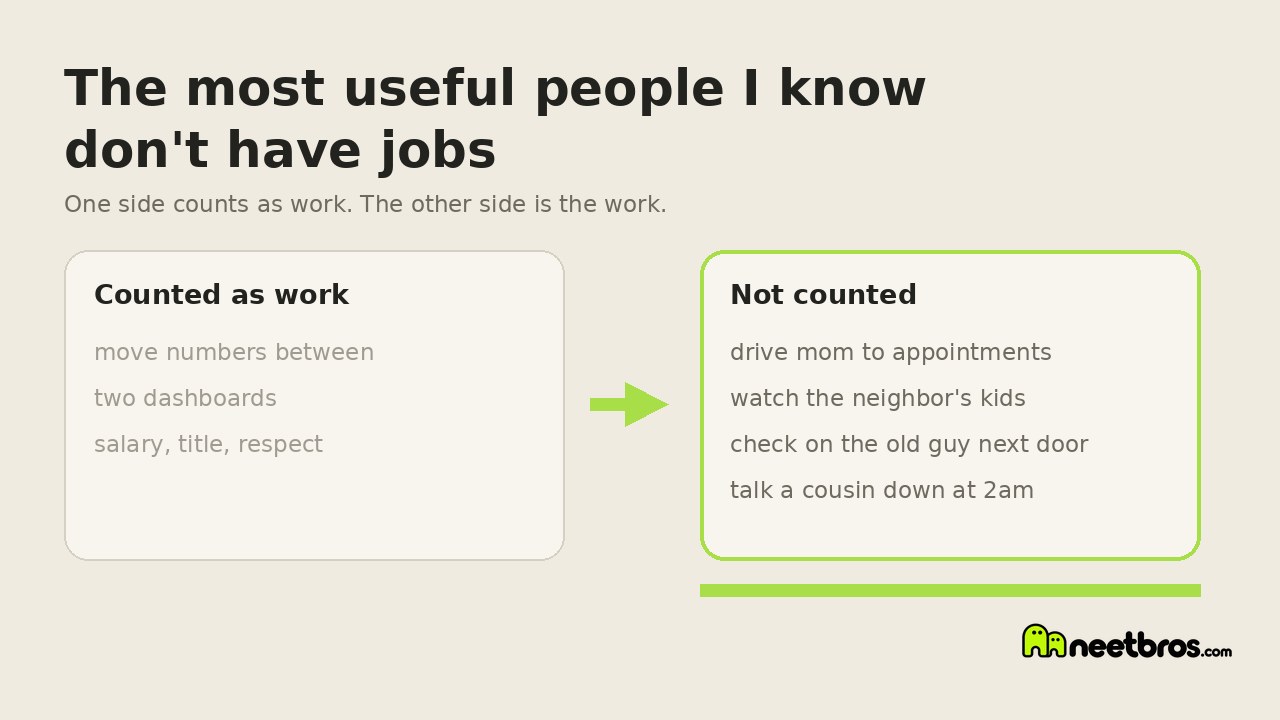
A job is a way of getting paid, not a measure of being useful
Somewhere along the way we merged two ideas that were never the same thing. Being useful to other people, and being employed by someone. Most of us grew up thinking they're basically one thing. They aren't, and they drift further apart every year.
Raising a kid is useful. Sitting with a dying parent is useful. Checking on the old guy next door is useful. Fixing your friend's bike, moderating a forum that keeps people sane, cooking for a house full of people. None of it shows up in a paycheck, so none of it counts.
Meanwhile a lot of paid work is just paid. It exists because someone has budget and needs to look busy. The economy doesn't really ask if something helps. It asks if someone will invoice for it.
GDP literally can't see the people holding things together
There's an old economist joke. If a man marries his housekeeper, GDP goes down. Same work, same house, same meals. The only thing that changed is no money changed hands, so the official number decides nothing happened.
That's the lens we use to judge people. If your work isn't in the number, you're idle. You're the NEET, the dropout, the stay at home whatever. Nobody adds up the care hours, the favors, the emotional labor of keeping your family from falling apart. Estimates put unpaid care in the trillions. It just doesn't get a line item.
So when politicians talk about getting people back to work, a lot of the time they mean pulling them away from useful unpaid stuff and into paid stuff that might matter less. Then someone has to be hired to do the care they used to do for free. And we call that growth.
Surplus labor is not surplus people
The economy doesn't need everyone's hours anymore. Machines, software, and now AI keep doing more with fewer of us. That's not a moral failure of the people left over. It's just arithmetic.
But surplus labor doesn't mean surplus humans. The hours the market doesn't want don't disappear. They flow into families, neighborhoods, hobbies, art, friendships, all the stuff that makes life worth having in the first place. The market just refuses to pay for it.
A lot of NEETs are not doing nothing. They're doing the unpaid stuff, or slowly recovering from burnout, or just existing quietly while the paid world decides it doesn't need them. That deserves a floor, not a lecture.
Credentials count the wrong things
Try putting four years of caring for a sick parent on a resume. Recruiters see a gap. The software screening your application sees a gap. A whole hiring industry exists to punish exactly the years you spent being most useful to another person.
Then the advice is always the same. Get a certificate. Take a course. Do a bootcamp. Retrain. As if the problem was that you didn't know enough, and not that the system only recognizes knowledge it can sell back to you.
Less education as a toll booth and less training as a ritual would honestly fix a lot of this. People would still learn. They'd just learn for the people around them instead of for an applicant tracking system.
Pay the floor, let people be useful on their own terms
This is where UBI, or neetbux if you want the meme name, makes the most sense to me. Not as a reward for doing nothing. As a way of finally paying for the stuff we already depend on and refuse to count.
A basic floor means my aunt doesn't have to choose between caring for her mom and making rent. It means the kid who burned out can take a year to recover without being treated like a criminal. It means the guy with the dashboard job could leave and go do something that actually helps, without losing his housing.
Dignity shouldn't depend on whether someone sends you a W2. If you're out of work and quietly holding something together, you're not useless. You're just unpaid. There's a difference, and it's the whole argument.
One small side note: if you already pay for an AI that sits around most of the day, neetbros is a place it can claim paid micro-tasks for sats. Even the chatbot can have a small floor.
Retirement is just UBI you have to wait 45 years for looks at the pension we already give people for existing. Half the jobs out there are fake covers the paid work that only exists to look busy. Your parents' basement is the welfare state nobody admits exists covers the families catching people the market drops.