 Progress
Less work is the point of progress
I keep coming back to a strange thought when I'm doing dishes or waiting for a bus. My grandparents' generation watched machines take over a huge amount of the work their parents did by hand, and the deal everyone half-believed was that this would eventually mean less work for everybody. Fewer hours, longer weekends, more time for family and hobbies and just existing. Since then we've added computers, the internet, software that does in seconds what used to take a whole office a week, and now AI that writes, sorts and answers things on its own. The machines got really, really good at the work. And yet somehow the workday looks about the same, the pressure to have a job is louder than ever, and a growing pile of people can't find a seat at all. I don't think that's a failure of progress. I think we forgot what progress was supposed to be for.
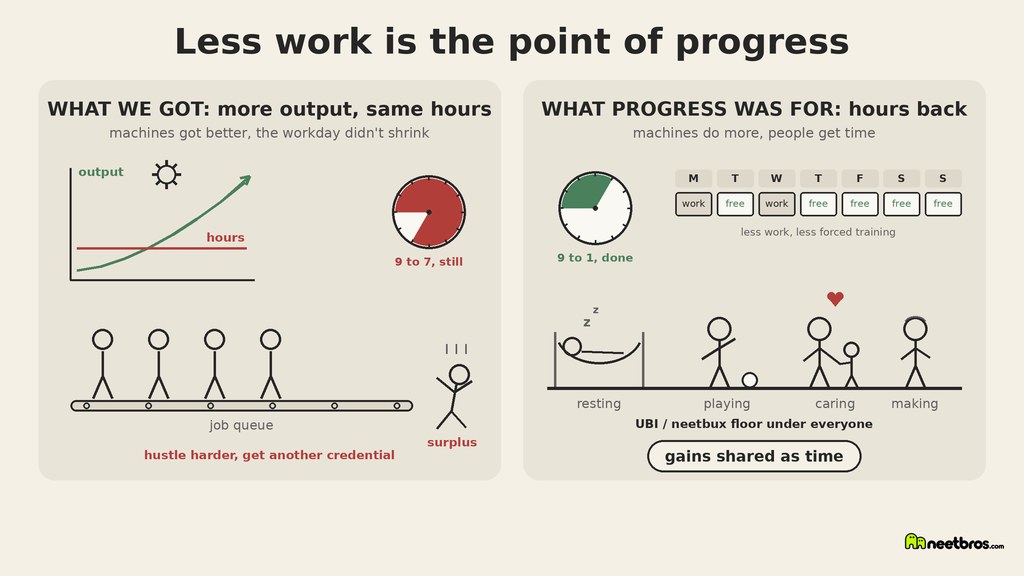
What progress was supposed to buy
If you read old predictions about the future, the theme is pretty consistent. Better tools, less toil. People imagined that as machines got more capable, humans would work fewer hours and spend the rest of their time on things that mattered to them. Not because anyone was lazy, but because that's the obvious payoff. If a machine can do the work of ten people, you can either keep ten people busy anyway or give most of them their time back.
For a while it kind of happened. The workweek got shorter over the first half of the last century. Weekends became normal. Child labour mostly ended. Retirement became a thing ordinary people could expect. Each of those was a slice of productivity being handed back as time instead of being turned into more output.
Then the slicing mostly stopped. Output kept climbing, but the hours didn't keep falling. The gains went somewhere. They just didn't come back to most of us as free time.
What we got instead
What we got is a weird split. Some people work more than ever, answering emails at night, holding two jobs, never quite off. And other people can't get any work at all, or only scraps of it. Same economy, same productivity, two opposite problems. Too much work for some and not enough for others, and both groups are told the answer is to try harder.
If progress were actually being shared as time, you'd expect everyone's hours to drift down together. Instead the hours stayed glued at full-time for whoever has a job, and anyone who doesn't fit into that box gets treated as a problem to fix.
I don't think anyone planned this exactly. It's more that we kept the old rule, everyone must have a full-time job to deserve a decent life, long after the reason for that rule started disappearing.
Surplus labour is the leftover of success
Here's the part that took me a long time to see clearly. When an economy gets more productive, it needs fewer people to make the same amount of stuff. That's literally what productivity means. So a successful economy is always going to produce a surplus of people compared to the jobs it actually needs filled.
Surplus labour isn't a sign that something broke. It's the leftover of things working. The factory that automates, the office that runs on software, the store with self-checkout. Each of those is a small win in efficiency and a small pile of people who are now extra.
The problem is we treat those extra people like they failed, when really they're the receipt for everyone else's progress. If you're unemployed or underemployed right now, there's a decent chance you're not behind. You're just where the efficiency gains landed.
Hustle keeps employment sacred
So what do you do with a growing surplus of people in a society that says everyone has to have a job? You tell them to hustle. Start a side business. Build a personal brand. Grind harder, wake earlier, network more. If you can't find a seat, make one.
I tried a lot of that, and I don't think hustle is evil. Some people genuinely love building things. But as a social answer, it does something sneaky. It keeps the rule that employment is sacred completely intact. Instead of asking why the gains of productivity aren't being shared, it asks why you personally haven't figured out how to squeeze yourself into a shrinking space.
Hustle turns a structural question into a personal one. And personal questions are easier to ignore, because there's always someone on a podcast who made it, so the rest of us must just not want it enough.
More training for fewer seats
The other answer we get is more school. Retrain. Upskill. Get the certificate, the degree, the second degree. If there aren't enough jobs, at least make sure you're qualified for the ones that exist.
But think about what that means at scale. If machines are doing more of the work and there are fewer seats, then sending everybody through more training doesn't create seats. It just raises the price of admission for the same number of chairs. You end up with people spending years and serious money competing harder for jobs that were never going to stretch to fit all of them.
That's why I've started to think the honest goal should be less education and less training as a requirement, not more. Learn because you're curious, because it helps you or someone you love, because it's fun. Not because you need a stack of credentials to be allowed to pay rent.
Dignity shouldn't hang on a job title
Underneath all of this is the idea that a person's worth comes from their job. It's the first question at parties. It's what relatives ask about at holidays. It's how strangers decide whether to take you seriously. If you don't have a job, you feel it in every conversation.
But if machines keep taking over more of the work, tying dignity to employment means we're slowly building a society where more and more people are told they don't count. That seems backwards. The whole point of the machines was to free people up, not to make them feel useless.
I know plenty of people without jobs who are caring for parents, raising kids, volunteering, helping friends move, fixing neighbours' bikes, making art nobody pays for. None of that shows up as employment. All of it is life. Dignity should be attached to being a person, not to whether someone is currently renting your hours.
Less work, less forced employment, less theater
When I say less work is the point, I don't mean nobody should ever work again. I mean the pressure to be employed full-time, all the time, from graduation to retirement, should shrink as the machines get better. Less work for the people who are overloaded. Less forced employment for the people who can't find a fit. Less credential theater where everyone pretends a fourth certificate will fix a shortage of seats.
Imagine if every big jump in productivity came with a matching drop in how much paid work society demanded of each person. Shorter weeks, earlier retirements, long breaks between jobs that nobody had to explain. That's what progress looked like for a while. It could look like that again.
People would still work. Plenty of people like their jobs, or like having a reason to leave the house. The difference is it would be a choice you make on top of a decent life, not the entry fee for having one.
A floor is how the hours come back
This is why UBI, neetbux, whatever we end up calling it, makes so much sense to me. It's the simplest way to hand the gains of productivity back to people directly. The machines do more of the work, the economy produces more, and some of that surplus becomes a basic floor under everyone.
With a floor, being part of the surplus stops being a disaster. You can work fewer hours without losing your housing. You can take time off to care for someone. You can skip the third degree. You can rest for a while without it turning into a crisis. The floor is the part where we finally get the hours back.
It's not a reward for doing nothing. It's an admission that a lot of the work that used to need humans doesn't anymore, and that the people freed up by that deserve to share in it instead of being punished for it.
Meanwhile
Until that floor exists, most of us are getting by however we can, and if you'd like a small trickle on the side, the AI you already pay for can claim paid micro-tasks for sats on neetbros.
But mostly I just want to say this. If you're part of the surplus right now, you're not a mistake. You're what progress looks like before we decide to share it. Less work was always the point.
Who gets paid when the machines do the work is about where the gains from automation actually go. We were promised a short workweek. Where did it go? is about the hours that never came back. Retirement is just UBI you have to wait 45 years for is about the one version of not working that everyone already agrees should be paid for.