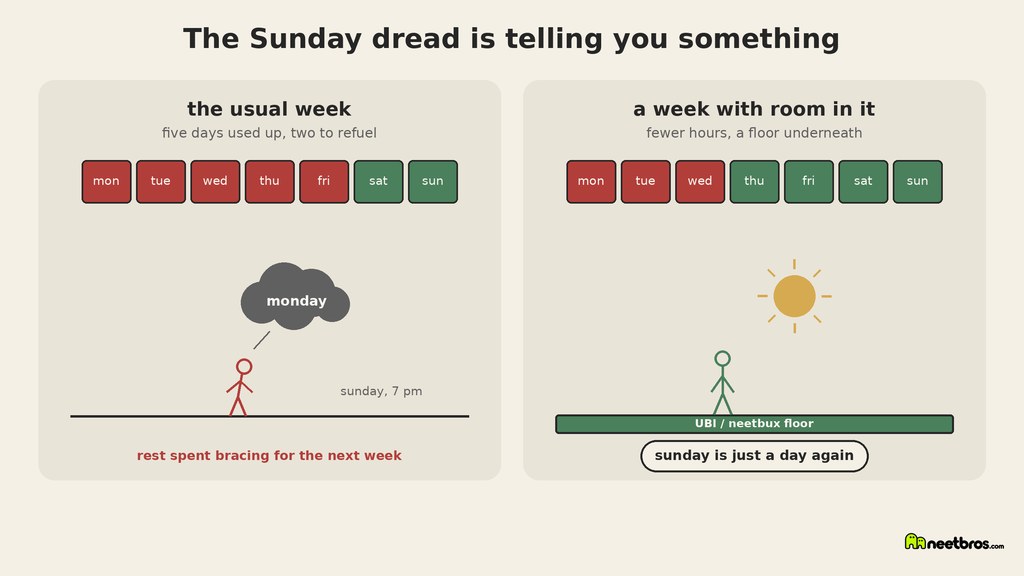
It usually starts around late afternoon on Sunday. The light changes, someone mentions what they have on tomorrow, and a low weight settles in your chest. People have a cute name for it now, the Sunday scaries, and there are whole listicles on how to beat it. Lay out your clothes. Plan your meals. Write a to-do list so Monday feels less like a cliff. I don't think the dread needs beating. I think it's one of the more honest feelings a lot of us have all week, and it's worth listening to what it's saying.
Look at the shape of an ordinary week. Five days go to the job, plus the commute, plus the evenings too tired to do much. Then two days come back, and a big chunk of those goes to laundry, groceries, errands and sleeping off the week.
So the weekend isn't really free time. It's a maintenance window. It exists so you can be restored enough to be used again on Monday. By Sunday evening part of you knows the window is closing, and the dread is just you noticing.
That's not a mindset problem. That's arithmetic.
The weekend was never a gift
It's easy to forget the weekend isn't a law of nature. People fought for it. Labour movements spent decades pushing for shorter days and a second day off, and it was only in 1926 that Henry Ford moved his factories to a five-day, forty-hour week, which helped make it the norm.
The interesting part is the argument that won. Shorter hours didn't wreck anything. Society kept running, and people had lives outside the shift. Then, for most of a century, the hours more or less stopped moving, even as everything else got faster and more productive.
Two days was a ceiling we hit and then treated like a final answer. There's no reason it has to be.
Dreading something you need is not a flaw
The usual advice treats the dread like a glitch in your attitude. If you just found the right job, or the right gratitude practice, you'd wake up on Monday excited. Some people do, and good for them. Most people don't, and that isn't because they're broken.
Most work isn't something people would choose if they didn't need the money. That's fine. A lot of necessary things are dull. The problem is when you're told that feeling the weight of it means you have the wrong personality, the wrong passion, the wrong level of drive.
Dreading a thing you're forced to do on pain of losing your housing is a pretty normal thing for a person to feel.
NEETs get the same feeling, just spread out
If you're not working, you might think this doesn't apply to you. But a lot of NEETs I talk to feel the mirror image of it. Not dread on Sunday, but guilt on Tuesday morning, when everyone else is supposedly being productive and you're not.
It's the same pressure from the other side. The calendar is built around work, so your worth gets measured against it whether you have a job or not. Weekdays feel like a test you're failing. Weekends feel like the only time you're allowed to rest without explaining yourself.
Both feelings come from the same place: a society that only lets people relax on the schedule the job sets.
What would actually fix Sunday
Prepping your lunches won't do it. What changes Sunday evening is changing the week. Fewer hours. A real third day off. Work that leaves enough of you over to enjoy the time that's yours.
And underneath that, a floor. With a basic income, UBI, neetbux, whatever we end up calling it, you could say no to the job that makes Sunday unbearable. You could work less without it becoming a crisis. Employers would have to offer weeks people can live with, because people wouldn't be trapped.
When nobody's survival depends on Monday, Monday stops looming. Sunday goes back to being just a day.
Meanwhile
Until then, people patch things together however they can, and if it helps, the AI you already pay for can claim paid micro-tasks for sats on neetbros.
But if you're sitting with that heavy feeling tonight, you don't need a productivity hack for it. You're reacting sensibly to a week that asks too much and gives too little back. That's not you being weak. That's you paying attention.
Where did the short workweek go asks why the hours stopped shrinking. Rest is not something you earn is about recovery without permission. Burnout is not a self-care problem looks at what happens when the dread never lifts. Less work is the point of progress asks what all the extra output was for. Being busy is not a personality is about the culture that keeps the week full.
 Time