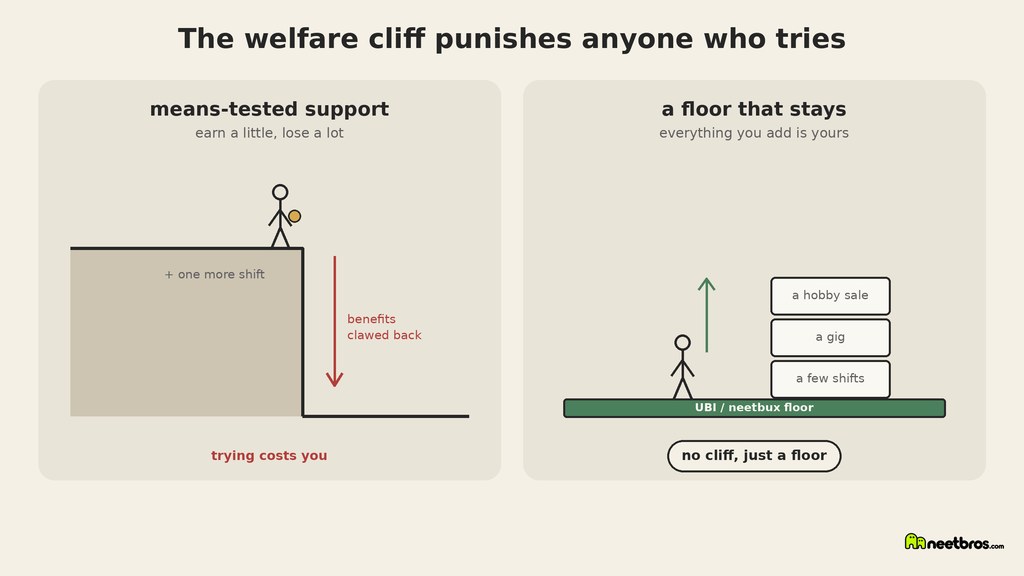
There's a particular kind of exhaustion that comes from being told to try harder by a system that charges you for trying. If you're on any kind of means-tested support, you probably know it. Earn a bit more and you lose a bit more, sometimes more than you earned. Then people look at you sitting still and call it a motivation problem. I don't think it is. I think the welfare cliff is one of the clearest examples of a society punishing the exact behaviour it says it wants, and then blaming the people who noticed.
If you've never been on benefits, here's the short version. Most support is means-tested, which means it shrinks as your income goes up. That sounds fair on paper. In practice it often shrinks faster than you earn. Pick up a few extra shifts and your payment drops, your rent help gets recalculated, maybe you lose a medication card or a childcare subsidy that was worth more than the shifts.
Economists have a dry name for this: effective marginal tax rates. People on the bottom rung regularly face rates that would cause a riot if anyone tried them on a surgeon. Keep thirty cents of the next dollar. Keep nothing. Sometimes go backwards.
That's the cliff. You walk toward the thing everyone tells you to do, more work, and the ground disappears.
It's rational to stand still
People love to say welfare makes people lazy. I think it makes people careful. If one extra day a week could cost you your housing support, and getting it back means months of forms and waiting, then not taking that day isn't laziness. It's basic arithmetic done by someone who can't afford to be wrong.
Nobody calls a rich person lazy for structuring their income to avoid a tax bracket. They call it planning. When a poor person does the same math with much higher stakes, it becomes a moral failure.
A lot of NEETs I know aren't avoiding work because they hate effort. They're avoiding a system where every bit of effort gets audited, clawed back, and used as evidence against them.
The paperwork is the punishment
The money is only half of it. The other half is the reporting. Every change in hours is a form. Every form is a chance to make a mistake. Every mistake can become an overpayment letter months later, asking you to pay back money you already spent on food.
Irregular work, which is most of the work available now, is the worst case. Gig hours, casual shifts, a bit of cash from selling old stuff. The system is designed around a steady salary or nothing, and anything in between gets treated as suspicious.
So people learn that the safest income is no income. Not because they want to be idle, but because idle is the only state the system knows how to process without drama.
More training won't fix a design problem
The usual answer is more programs. Back-to-work schemes, mandatory courses, résumé workshops, a caseworker checking that you applied to enough jobs this week. More school, more training, more proof of trying.
None of that touches the cliff. You can finish every course on offer and still face the same math the moment you take a part-time job. Training people to climb toward a drop-off is a strange use of everyone's time.
It also keeps the whole thing framed as a personal deficiency. If you just had better skills, the story goes, you'd jump straight past the cliff into a full-time salary. For a lot of people, especially in a labour market with more people than good jobs, that jump simply isn't there.
Dignity means not being checked all the time
There's something corrosive about having your income watched like a suspect. Every relationship, every side gig, every gift from a parent becomes something you might have to declare. You start to feel like you're on probation for being poor.
We don't do this to retirees on a pension. We don't do it to homeowners getting a tax break. The constant checking is reserved for the people with the least room to absorb a mistake.
Dignity isn't just having enough money. It's being trusted to live your life without filing a report on it.
A floor doesn't have a cliff
This is the boring, structural reason I keep coming back to UBI, neetbux, whatever we end up calling a basic floor. A floor that everyone gets and nobody loses doesn't have a cliff. Whatever you add on top, a few shifts, a gig, a hobby that sells something now and then, is yours. Effort is always worth it, because nothing gets taken away when you make it.
It's almost funny. The policy people call the soft option is the only one where working a little more always pays. The tough-love system, with all its checks and conditions, is the one that teaches people trying is risky.
And for the people who don't add anything on top, who need the floor and nothing else for a while, that's fine too. A society that produces this much can carry people through a quiet stretch without making them prove they deserve it every month.
Meanwhile
Until a floor like that exists, people stitch together small income however they can, and if it helps, the AI you already pay for can claim paid micro-tasks for sats on neetbros.
But mostly I want anyone stuck on the edge of that cliff to hear this. You're not lazy for doing the math. You're responding sensibly to a system that punishes the exact thing it claims to want. The fix isn't you trying harder. It's taking the cliff away.
Looking for work is a job that pays nothing covers the unpaid labour of job hunting. Help shouldn't feel like a trial looks at how support gets wrapped in suspicion. Gig work is unemployment with an app is about irregular income. We produce enough. We ration dignity. asks why abundance still comes with conditions. A small life is not a failed life defends wanting enough and no more.
 Benefits