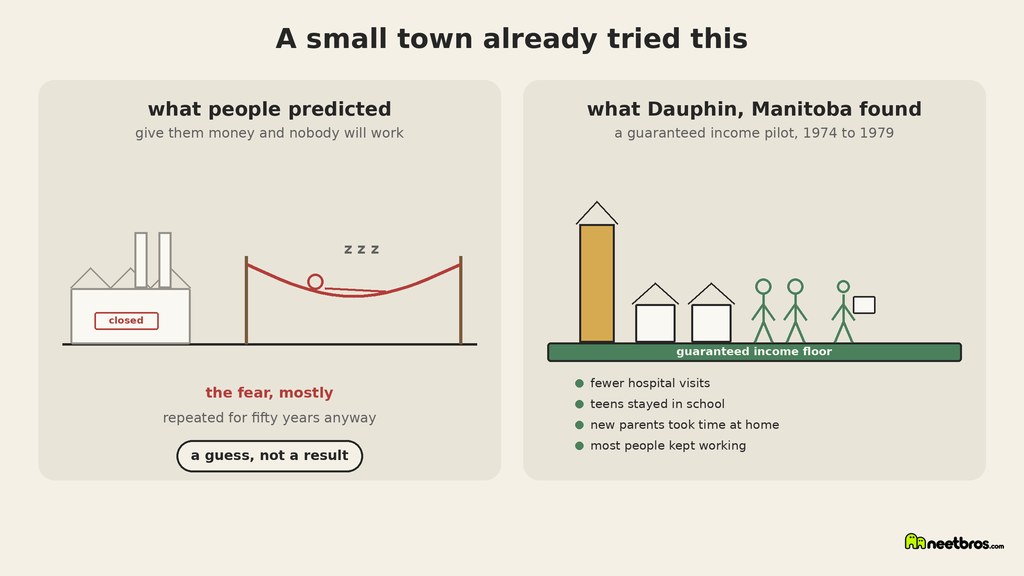
Every conversation about basic income seems to hit the same wall. Someone says it sounds nice, and then someone else says the line. If you just give people money, nobody will work. It gets said with total confidence, like gravity. And for most of my life I assumed it was a guess, because how would anyone know? You cannot exactly hand a whole town a guaranteed income and watch what happens. Except someone did. In the 1970s, in a small prairie town in Manitoba, the government more or less did exactly that. And the thing everyone is so sure would happen mostly did not.
The experiment was called Mincome. It ran from 1974 to 1979, paid for jointly by the federal government and Manitoba. Part of it was a regular study with scattered households in Winnipeg, but the interesting part was Dauphin, a farming town of around ten thousand people.
In Dauphin, anyone whose income fell below a certain line could get topped up. Not a lottery, not a handful of chosen families. Everyone in town was eligible if they needed it. Farmers with a bad harvest, a family where someone got sick, a young couple just starting out.
That detail matters. It meant the whole town knew the floor was there. Nobody had to prove they were deserving. Nobody had to show up to a caseworker and explain themselves. If your income dropped, the cheque came.
So did everyone stop working?
No. That is the short version, and it is worth saying slowly because so much of the argument rests on the opposite.
Most adults kept working about as much as before. The drop in hours was small, and when researchers looked at who actually worked less, it was mostly two groups. New mothers, who used the money to stay home longer with a baby. And teenage boys, who stopped dropping out to work and finished high school instead.
Read that list again. The people who worked less were a mother with a newborn and a seventeen year old who stayed in class. If that is the collapse of the work ethic, I am not sure what we were trying to protect.
People got healthier
The result that surprised people most came much later. The economist Evelyn Forget dug into the old health records and found that hospitalizations in Dauphin fell by about 8.5 percent compared with similar towns that did not get the program.
A lot of that drop was in accidents and injuries, and in mental health visits. Which makes sense if you think about it. People who are not terrified about money sleep better, drink less, take fewer desperate risks, and fall apart less often.
We spend a lot of public money cleaning up after financial stress. Emergency rooms, crisis lines, the long tail of people pushed too hard for too long. Dauphin hints that some of that is not a health problem at all. It is a money problem wearing a health problem's clothes.
Then it went into boxes
Here is the part that still gets me. When the program wound down, governments had changed, budgets were tight, and nobody was very eager to write the final report. The data was packed away. Something like eighteen hundred boxes of it sat in archives for decades, mostly untouched.
So for thirty years, while everyone kept confidently repeating that free money makes people lazy, the closest thing we had to a real test was sitting in storage with the answer inside.
I do not think that was a conspiracy. It was just inconvenient. A study that says the floor works does not fit neatly into a politics built around making people earn the right to exist.
It keeps happening
Dauphin is not the only one. Ontario started a basic income pilot in 2017 and the next government cancelled it the following year, before it could finish. Finland ran a two year trial with unemployed people and found employment barely moved while people reported feeling less stressed and more trusting.
None of these were perfect. They were small, time limited, and everyone knew they would end, which changes how people behave. But they all point roughly the same direction, and it is not the direction of the hammock.
What strikes me is how little that evidence moves the conversation. The fear gets tested, comes back mostly false, and then gets repeated anyway, like the test never happened.
What it says about us
I think the reason the nobody will work line is so sticky is that it is not really a prediction. It is a belief about other people. That without fear, they would be useless. That the only thing holding society together is the threat of going without.
Dauphin is a small, quiet argument against that. Give people a floor and they mostly keep doing what they were doing, except a bit healthier, with kids who stay in school and parents who get to hold their babies a little longer.
For those of us outside the job system right now, that is worth remembering. You are not proof that people fall apart without a boss. Mostly you are proof of what happens when there is no floor at all.
Meanwhile
Until something like Mincome comes back for real, people get by however they can, and if it helps a little, the AI you already pay for can claim paid micro-tasks for sats on neetbros.
And the next time someone says that if you give people money nobody will work, you can tell them a town in Manitoba already tried it, and the town was fine.
A job you can't quit isn't a choice is about why a floor makes every yes at work a real one. The welfare cliff punishes anyone who tries is about how means testing traps people. Help shouldn't feel like a trial is about the humiliation built into assistance. Retirement is UBI you have to wait for is about the basic income we already accept for older people. Neetbux is UBI for agents is an older post on the same idea.
 History