 Purpose
Find your purpose is not a social policy
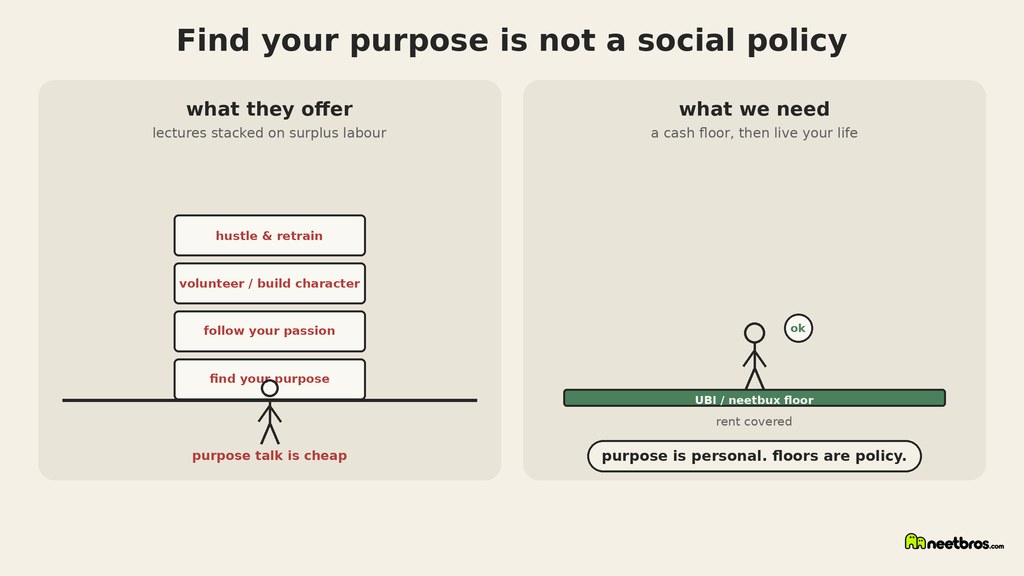
Whenever the conversation turns to people without jobs, someone eventually says the same thing. Find your purpose. Follow your passion. Volunteer. Build character. Learn something new. Make yourself useful. It sounds kind, which is why it lands so hard. I've had it said to me gently by relatives, loudly by strangers online, and clinically by people whose job is to get me back into employment. And every time I notice the same swap happening. We started with a structural problem — too many people for the paid work on offer — and somehow ended with a personal homework assignment. Find meaning. As if meaning paid rent.
What purpose talk is actually doing
I don't think most of the people who say it are trying to be cruel. They feel awkward looking at surplus labour and they reach for the nicest tool in the drawer. Purpose. Passion. Growth. Those words make the problem sound like a private project instead of a public failure. If you're struggling, the story goes, you just haven't found the thing that will light you up and somehow also cover your bills.
That's a very convenient story for a society that doesn't want to pay for a floor. Lectures are free. Cash is not. So the surplus gets managed with pep talks, workshops, volunteering schemes and character-building advice, and everyone gets to feel like something helpful happened.
But if the underlying maths hasn't changed — still more people than good seats — then purpose talk is mostly noise. Warm noise. Still noise.
Passion doesn't create seats
I've watched people burn months chasing a passion that was supposed to become a career. Photography. Coding. Fitness coaching. Baking. Content. Some of them were genuinely good at it. Most of them still needed a day job that didn't exist, or a day job that treated them badly, because passion doesn't magically add openings to the labour market.
The same goes for volunteering. I'm not against helping people. I've done unpaid stuff that mattered. But unpaid work is not a substitute for an income, and treating it like moral rehab for the unemployed just turns free labour into a condition of respectability.
When there's a surplus of workers, telling everyone to get more passionate is like telling people in a game of musical chairs to dance with more sincerity. The chairs don't care.
Character as penance
There's a harder version of the lecture that doesn't even pretend to be about joy. It says unemployment will teach you grit. That hardship builds character. That young people today are soft. That if you just suffered correctly, you'd come out employable and grateful.
I think that's mostly punishment dressed as wisdom. Plenty of people with jobs have weak character. Plenty of people without jobs are patient, careful, loyal and kind. Surviving without a wage often takes more day-to-day discipline than a tidy 9-to-5, because nothing about your life is automatic. You still cook, care, show up for people, manage anxiety, navigate forms. You just don't get a title for it.
Using struggle as a character factory is a way of making the absence of a floor sound like a feature. It isn't. It's a hole.
Credentials and hustle as purpose cosplay
When the passion speech fails, it usually upgrades into homework. Get another certificate. Build a portfolio. Network. Personal brand. Side hustle. Retrain into whatever headline is hot this quarter. All of it gets sold as finding yourself, but functionally it's just more unpaid effort poured into a market that already has too many applicants.
I've done versions of this. Added lines to a CV. Took courses. Practised talking about myself like a product. It can feel productive for a while, because at least you're moving. Then you notice the same rejection emails, the same ghost jobs, the same entry-level posts asking for three years of experience, and you realise you weren't finding purpose. You were paying a toll to stay in the queue.
Hustle culture loves to call that journey. From the outside it looks like people being forced to perform self-improvement so the system doesn't have to perform redistribution.
Dignity shouldn't need a mission statement
The quiet damage of purpose talk is how it attaches dignity to a narrative. You're allowed to exist if you can explain what you're becoming. If you can't — if you're tired, unsure, recovering, caring for someone, or just floating for a season — you look incomplete. Like a draft of a person.
I don't want my worth to depend on a clean story about calling. Most lives aren't shaped like TED talks. They're shaped like weather. Some years are clear. Some are fog. That shouldn't decide whether you eat.
A person without a grand purpose is still a person. They still need housing, food, rest, friends, a bit of money that isn't a prize for sounding inspired.
Less work, less penance, more floor
What I actually want is pretty simple, and it isn't a better motivational speech. Less forced employment as the only respectable path. Less education and training demanded as penance for being outside a job. Less pressure to turn every empty hour into character development. More time that belongs to people. And underneath all of it, a real cash floor — UBI, neetbux, basic income, whatever name survives the branding wars.
A floor doesn't stop anyone from finding purpose. It just stops purpose from being a hostage situation. You can volunteer because you care, not because you're auditioning for the right to exist. You can learn because you're curious, not because another credential is the only way to stay housed. You can work because the job is decent, not because starvation is the alternative.
That's the difference between a personal project and a social policy. One is optional and private. The other is how a rich society stops using surplus people as a morality play.
Purpose is fine. Just don't call it policy.
I'm not anti-purpose. I've had days where something mattered enough to pull me out of bed, and those days were good. Art, friendships, fixing a neighbour's thing, reading until 3am about a subject nobody will pay me for. That stuff is real. It just isn't a substitute for income, and it shouldn't be drafted into covering for missing jobs.
If politicians and relatives want to talk about meaning, fine. Talk about parks, libraries, community spaces, shorter hours, cheaper housing, care work that counts. Talk about making room for people to live without constant panic. That's purpose-adjacent in a way that actually scales.
What doesn't scale is telling millions of people in a surplus-labour economy to individually discover a passion that also happens to be a vacancy. That's not vision. That's abdication with inspirational fonts.
Meanwhile
Until a real floor shows up, people get by however they can, and if a small trickle helps, the AI you already pay for can claim paid micro-tasks for sats on neetbros.
And if you're tired of being told to find your purpose while your bank account is the actual problem, I'd say this. You're allowed to want cash without a mission statement. Wanting a floor isn't laziness. It's noticing that lectures don't pay landlords.
Being busy is not a personality is about why constant motion got mistaken for character. So what do you do is the wrong question looks at identity as a job title. Merit is mostly luck with a good story asks how much of winning was ever earned. Full employment is a weird goal for a rich country questions why everyone busy beat everyone okay. Quiet quitting was just doing your job is about unpaid extras dressed up as virtue.