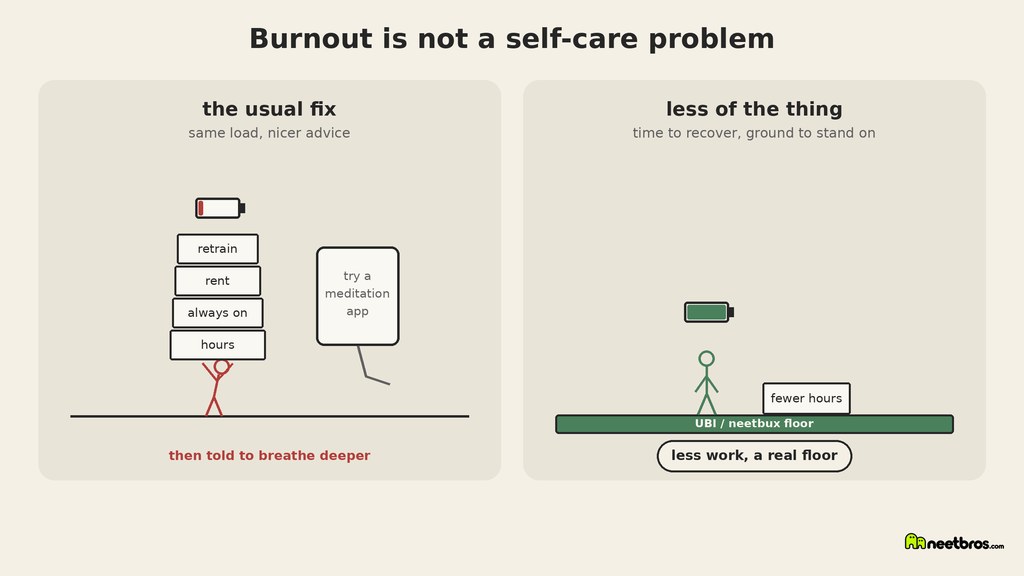
At some point every workplace discovered burnout and decided the answer was a webinar. A lunchtime session on resilience, a meditation app subscription, a reminder to drink water and set boundaries. None of that is evil. Some of it even helps for a day. But I keep noticing how neatly it moves the problem. Something caused by too much work, too little control and too little security gets rebranded as something you failed to manage in yourself. I don't think that's an accident, and I don't think it's true.
The World Health Organization describes burnout as an occupational phenomenon. It isn't listed as a medical condition you just happen to catch. It's described as what comes from chronic workplace stress that hasn't been successfully managed. The cause is right there in the wording: the workplace.
And yet when it shows up, the fix almost always lands on the person. Try a gratitude journal. Get more sleep. Take a mental health day, then come back and do the same thing that wore you down. It's a bit like treating a leaking roof by handing everyone underneath it a nicer towel.
I'm not knocking towels. I'm just saying the roof is still leaking.
Self-care became another task on the list
There's something almost funny about how self-care turned into homework. Now you're tired from work, and also behind on your morning routine, your step count, your mindfulness streak and your hydration goal. Rest became something you have to optimise and track, which is just work wearing softer clothes.
If you can't recover, the implication is that you weren't doing the self-care right. You didn't set firm enough boundaries. You didn't say no. As if most people in a precarious job can just say no to their manager and keep the job.
That's the quiet trick. A problem with the shape of the economy gets handed back to individuals as a personal skill they're lacking.
Exhaustion is a reasonable response
When people are asked to work long hours, stay reachable after hours, compete against a pile of other applicants for every role, keep retraining for the next certification, and do it all with rent rising and no real safety net, getting worn down isn't a malfunction. It's a pretty sensible reaction.
A lot of NEETs I talk to didn't drop out because they were lazy. They dropped out because they burned out early, sometimes before they even had a proper job. School, then more school, then internships, then the application grind. By the time the actual career was supposed to start, the tank was already empty.
Calling that a personal failing feels backwards. You don't blame a phone battery for dying after being left on full brightness for a decade.
The only reliable cure is less of the thing
Here's the boring answer that nobody puts in a wellness newsletter. The most effective treatment for being burned out by work is usually less work. Fewer hours. Less pressure. More time when nobody needs anything from you. Real recovery takes weeks or months, not a long weekend.
Most people can't afford that, and that's the actual issue. Burnout recovery is mostly a question of money. If stepping back means losing your housing, you don't step back. You keep going, quietly worse every month, until something forces the break for you.
So the people who most need to stop are the ones who can least afford to, and the advice they get is to breathe deeply and keep showing up.
A floor is a better wellness program
This is why I think UBI, neetbux, whatever we end up calling it, is closer to a health policy than a handout. A basic floor means you can actually leave a job that's grinding you down. You can work fewer hours. You can take the months it really takes to recover without it turning into a crisis.
It also changes the job itself. When people aren't trapped, employers have to make work survivable to keep them. The pressure to wring every last hour out of someone gets weaker when that someone has somewhere else to stand.
No meditation app does that. A floor does.
Meanwhile
Until something like that exists, people get by however they can, and if it helps, the AI you already pay for can claim paid micro-tasks for sats on neetbros.
But mostly, if you're burned out right now, I want you to hear this plainly. You didn't fail at self-care. You were asked to carry too much for too long with nothing underneath you. Needing to stop isn't weakness. It's information.
Rest is not something you earn looks at why recovery shouldn't need permission. Upskilling is a treadmill covers the endless retraining. Being busy is not a personality is about the culture that keeps us running. Less work is the point of progress asks why the hours never came down. Someone is unemployed on purpose looks at who the economy leaves outside by design.
 Work