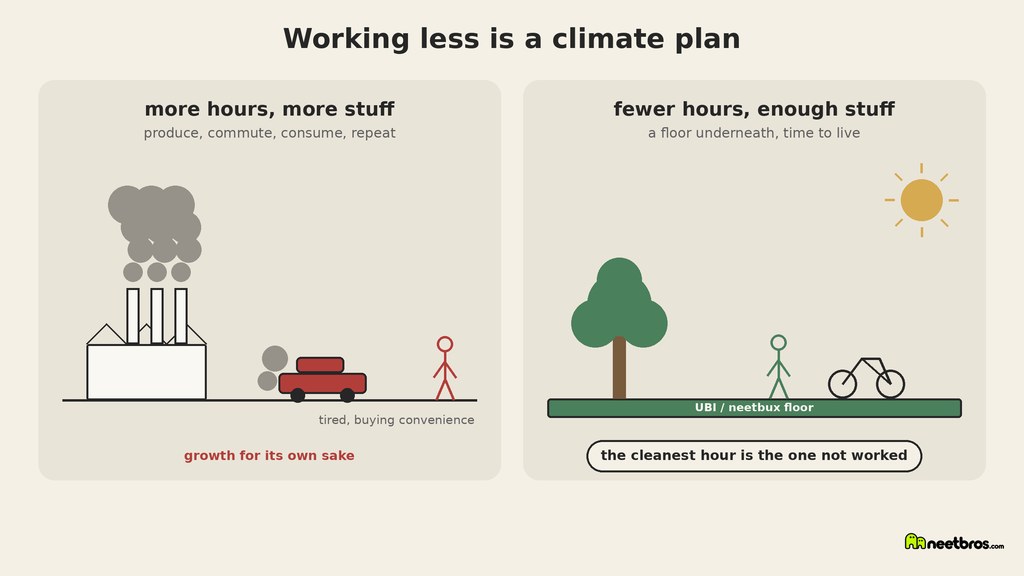
Every so often someone lectures people like us about being unproductive. Not working, not contributing, not pulling our weight. And then, in the same week, the same people will tell you the planet is in trouble because we make too much, ship too much, burn too much and throw too much away. I keep waiting for someone to connect those two thoughts out loud. So here goes: a lot of the work we are told to feel guilty about not doing is the work that is cooking the place.
Think about what a full-time job actually adds to a life beyond the paycheque. A commute, usually by car. Lunches bought because there was no time to make one. Takeout at night because you are too tired to cook. Clothes for the office. Gadgets and subscriptions to make the little free time feel worth something.
None of that is a moral failing. It is what tired people do. When time is scarce, people buy convenience, and convenience almost always comes with packaging, shipping and fuel attached.
Researchers have noticed this at the scale of whole countries too. Work by the sociologist and economist Juliet Schor and others has found that places with longer working hours tend to have bigger environmental footprints. More hours, more output, more stuff, more burning.
A job for its own sake is a strange goal
Our whole economy is set up so that people only get to eat if they are employed. That sounds fair until you follow it through. If everyone has to have a job, then jobs have to be invented, and if jobs have to be invented, something has to be produced and sold to pay for them.
So we end up making things nobody really needed so that people can earn the right to buy other things nobody really needed. Growth stops being a way to make life better and becomes the thing that keeps the employment machine running.
If you only cared about the planet, you would never design it that way. You would ask how little work it takes to give everyone a decent life, and then you would stop there.
Surplus labour is not a crisis
We already have more people than the economy knows what to do with. Machines and software keep getting better, and every year the same output takes fewer hands. We call this a problem. We call the people left over a problem.
But a rich society that can meet its needs with less work is not in trouble. It is succeeding. Keynes wrote in 1930 that his grandchildren might only need to work around fifteen hours a week. He was not wrong about the productivity. He was wrong about what we would do with it.
Instead of taking the gain as free time, we took it as more production, and the bill for that is showing up in the weather.
Living small is not the problem
A lot of NEETs I know live pretty quietly. Second-hand clothes. Cooking at home. No commute. Not much travel. A cheap hobby or two and a lot of reading, walking and gaming.
Nobody calls that a climate win. They call it a wasted life. But if you added up what that life burns compared to the one we are supposed to want, with the car, the flights, the constant upgrades, it is not close.
I am not saying unemployment is secretly heroic. I am saying it is strange to shame people for doing the one thing everyone admits we need more of, which is consuming less.
A floor makes less possible
The reason people cannot just work less is that the floor is missing. Drop your hours and you might lose your rent, your healthcare, your standing. So everyone clings to full time, and the whole system keeps running hot.
A basic income, UBI, neetbux, whatever we end up calling it, changes the trade. If survival is covered, people can choose fewer hours. Some will take a four-day week. Some will step out for a while to care for someone or just rest. Fewer commutes, fewer rushed purchases, less pressure to invent work to keep wages flowing.
It is not the only climate policy we need. But it is one of the few that makes people's lives better while asking the planet for less, instead of asking already-stretched people to sacrifice more.
Meanwhile
Until that floor exists, people get by however they can, and if it helps, the AI you already pay for can claim paid micro-tasks for sats on neetbros.
And if anyone tells you that your quiet, low-key life is a drain on society, it is fair to ask them what exactly they would like you to produce more of. The planet does not seem to be asking for it.
Less work is the point of progress asks what all the extra output was for. Where did the short workweek go looks at why the hours stopped shrinking. Fake jobs are UBI with a commute is about work that exists mostly to justify a paycheque. A small life is not a failed life is about the dignity of living quietly. The Sunday dread is telling you something is about a week that asks too much.
 Planet