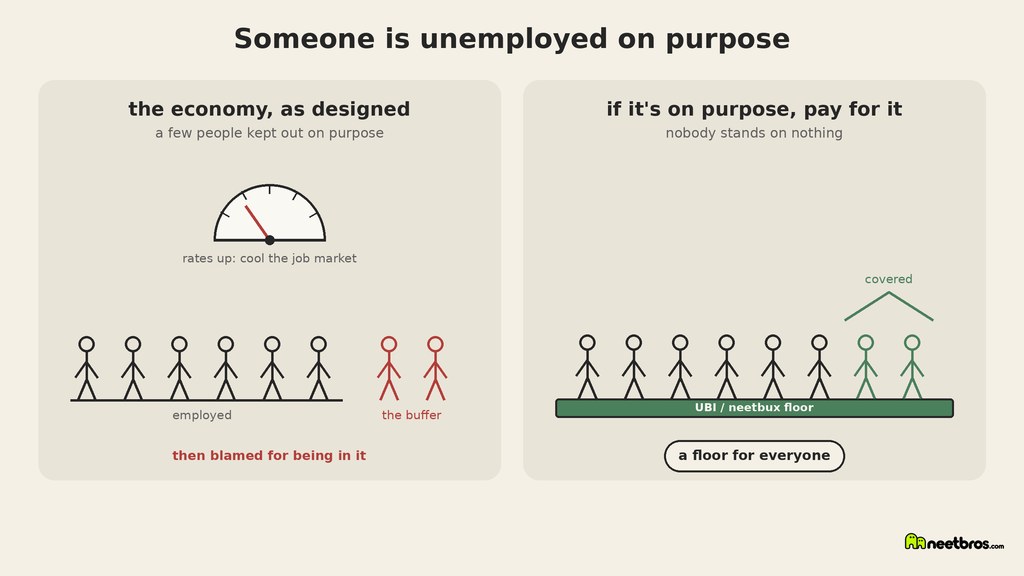
Most of us grew up thinking unemployment is what happens when people don't try hard enough. Then at some point you find out that the people running the economy actually plan for a certain amount of it. Not as a conspiracy, just as standard policy, written about openly. Once you know that, a lot of the advice aimed at jobless people starts to sound a bit off. If someone has to be out of work for the system to run smoothly, maybe the person who happens to be out of work isn't the problem.
When prices start climbing, the standard move is for the central bank to raise interest rates. Borrowing gets more expensive, businesses slow down, hiring cools off, and some people lose their jobs or never get one. That isn't a side effect anyone hides. Cooling the labour market is literally one of the ways it's supposed to work.
Economists even have names for the level of unemployment an economy is meant to sit at, the natural rate, or the rate that doesn't push inflation up. You can argue about the exact number. What you can't really argue about is the idea underneath it: a modern economy is run on the assumption that some people will be out of work at any given time.
I don't say this to be edgy. I say it because almost nobody tells the people in that group. They get told to polish the résumé.
A seat that's empty by design
Think about what that means for someone scrolling job boards for the fourth month. The system isn't trying to get everyone hired. It's trying to keep a certain amount of slack in the labour market so wages don't rise too fast. Somebody has to be the slack.
It's a bit like a theatre that sells fewer tickets than there are people in line, on purpose, so the price stays where it is. Then someone walks along the line telling each person left outside that they should have arrived earlier, dressed better, practised their handshake.
Individually, any one person might get in by trying harder. Collectively, the line stays the same length. That's the bit the motivational advice can't touch.
Effort just changes who's standing outside
This is why I've stopped being impressed by stories of someone grinding their way out. Good for them, honestly. But if the number of people who need to be outside is set by policy, every success story is mostly a reshuffle. Someone else is in the buffer now.
Same with training and credentials. If everyone gets the certificate, the bar moves and the buffer stays. More education can change your odds in the queue. It doesn't change how many people the queue is built to leave behind.
So when someone treats long-term unemployment as a character flaw, they're blaming individuals for the output of a dial someone else is turning.
They're doing a job, kind of
Here's the strange part. If some joblessness helps keep prices stable for everyone, then the people who are unemployed are, in a dry economic sense, providing a service. They're the shock absorber. Everybody with a mortgage and a pension benefits from that buffer existing.
And in return they get suspicion, paperwork, and a steady background hum of shame. They're asked to prove every week that they're trying to escape a role the economy needs someone to fill.
You don't have to love that framing. But it's at least more honest than pretending the buffer is just a collection of lazy people who happen to be in the same spot.
If it's on purpose, pay for it
This is where I land every time. If a society decides it needs some of its people out of work, it owes those people a decent floor. Not a means-tested maze, not a probation period, just enough to live with some dignity while they hold that line for everyone else.
That's one more reason I keep coming back to UBI, neetbux, whatever name sticks. A floor everybody gets means the buffer isn't a punishment. Whoever happens to be outside this year isn't falling through anything. They're standing on the same ground as everyone else, just with fewer hours.
It also takes some of the cruelty out of the whole game. If being out of work stops meaning being broke and ashamed, people can take the time to find something that fits, care for someone, recover, or just rest, instead of panicking into the first thing that will have them.
Meanwhile
Until a floor like that exists, people get by on small things, and if it helps, the AI you already pay for can claim paid micro-tasks for sats on neetbros.
But mainly, if you're in the buffer right now, I want you to know the math was never about you personally. A seat was always going to be empty. You're just the one sitting outside it this time, and that deserves support, not a lecture.
The job market is musical chairs looks at why there aren't enough seats to begin with. Full employment is a weird goal for a rich country asks what we're even aiming for. Overqualified is a polite word for not enough jobs covers the credential side. The welfare cliff punishes anyone who tries is about what happens when you do find a few hours. Help shouldn't feel like a trial looks at the suspicion that comes with support.
 Economy