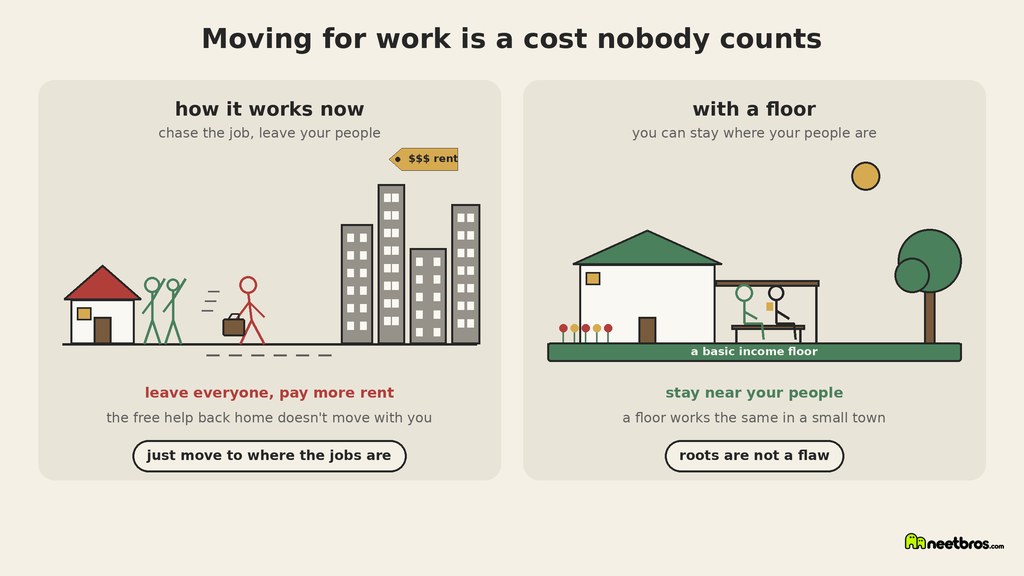
There is a piece of advice that shows up any time someone says there is no work where they live. Just move. Move to the city, move to where the jobs are, move across the country if you have to. It gets said like it is free, like you pack a bag on Friday and start a new life on Monday. But moving for work is one of the biggest costs a person can carry, and almost nobody counts it. Not the money, which is bad enough. The people, the places and the quiet help you leave behind. I want to talk about that, because I think it says a lot about what we expect people to give up just to be allowed to earn a living.
SocietyUBIMoving for workSmall townsCommunityBasic incomeLess workNEET
Moving for work is a cost nobody counts
"Just move" is a lot of words hiding in two
When someone says just move, what they mean is: save up first and last month's rent in a more expensive city, find a place while you are still somewhere else, quit what you have, leave everyone you know, and hope the job you are chasing is still there when you arrive.
And if it does not work out, you are now broke in a place where nobody knows you, instead of broke in a place where your aunt could at least feed you on Sundays.
The people who say it are usually people who already moved with a safety net, or who had a job lined up and a company paying for the truck. That is a very different move from the one a broke person is being told to make.
The jobs moved to where rent is highest
There is a strange loop in this. The places with the most jobs tend to be the places where housing costs the most, because everyone else was told to move there too.
So you move for higher pay, and a big chunk of that higher pay goes straight to a landlord. You end up working more hours in a nicer city that you cannot really afford to enjoy, sharing a flat with strangers at an age when your parents had a house.
Meanwhile the town you left had cheap rent and empty houses, and nothing to do for money. It is like the economy put all the chairs in one room and then charged admission to get in.
You leave behind the help nobody pays for
Back home there might be a grandparent who watches the kids, a friend who fixes your car for a case of beer, a neighbour who checks on your mom when she is not well. None of that shows up in a wage. All of it is real.
When people move for work, that web gets cut. Now the childcare costs money. The car repair costs money. Your mom is alone and you are calling her from a bus. The new job has to pay for all the things that used to be free, and it usually does not.
Economists like to say people should go where they are most productive. But a person is also productive at home in ways no one measures, just by being around for the people who need them.
Small towns do not die by accident
You have probably seen it or lived it. The mill closes or the plant moves, the young people leave because they were told to, and the main street slowly turns into empty windows and a dollar store.
Then people talk about those towns like they failed, like the people who stayed were too stubborn or too lazy to leave. But the town did not fail. Work got pulled out of it, and everyone was told it was their job to chase it.
The people who stay are often the ones holding things together. The ones looking after aging parents, coaching the kids' team, keeping the church or the rink or the legion hall alive. That is not nothing. That is a community, and it runs on people being allowed to stay.
Roots are not a character flaw
There is an idea in hustle culture that being tied to a place is weakness. That the ideal worker is someone who can be picked up and dropped anywhere the market needs them, with no friends, no family duties and no attachment to anything.
That is a description of a part in a machine, not a person. Most people want to be near the people they love. Wanting that is not a lack of ambition. It is just being human.
We do not tell rich people to move away from their families to earn their keep. Their money follows them wherever they want to live. It is only people without money who are told their roots are something they need to rip out.
What a floor would change
A basic income, or neetbux, works the same in a small town as it does in a big city. It does not care where you live. That alone flips the whole thing around.
With a floor under you, staying home stops being a gamble. You can live where rent is low, near the people who help you and the people you help. You can take the part time work that exists locally, or none at all for a while, without the pressure to uproot your whole life for a job that might not last a year.
And if you do want to move, a floor makes that easier too. You can move because you want a new life, not because you were forced out. A choice you can actually say no to is the only kind worth calling a choice.
It might even bring some towns back. People with a steady floor spend money where they live. They open small things, fix up old houses, stick around. Life comes back to places when people are allowed to stay in them.
You are allowed to stay
If you are a NEET in a small town, or living back home, or stuck somewhere people keep telling you to leave, it is okay to want to stay. Being where your people are is not a failure. Plenty of good lives are lived in places that never show up on a jobs report.
Small help in the meantime still counts, wherever you happen to be, and the AI you already pay for can claim paid micro-tasks for sats on neetbros.
A small town already tried this is about a real basic income experiment in a small Canadian town. Your commute is an unpaid shift is about the hidden hours we give to getting to work. Your job was never your community is about where belonging actually comes from. Nobody tells a landlord to get a job is about who gets judged for not working.
 Society