 Society
The weekend was a protest, not a gift
Saturday morning feels like a law of nature. You wake up, nobody needs you, and the day is yours. It is easy to forget that this is a pretty recent invention. For most workers in the early industrial era there was no weekend. There were long days, six of them a week, often with kids on the factory floor. The weekend did not arrive because bosses got generous. It arrived because a lot of ordinary people refused to keep living the old way, and kept refusing until the rules changed. That history matters if you are a NEET wondering whether wanting less work is a character flaw.
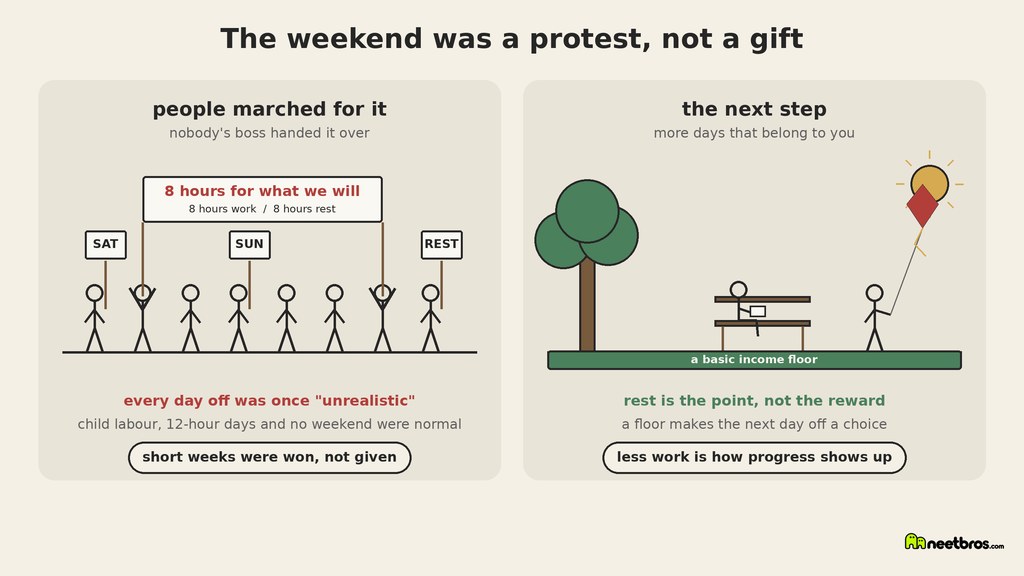
Every day off was once unrealistic
The old labour slogan was eight hours for work, eight hours for rest, eight hours for what we will. When people first said it, it sounded naive. Business owners warned it would ruin the economy.
In Toronto in 1872, printers went on strike for a nine-hour day. In the United States, the eight-hour movement held a mass strike on May 1, 1886, which is part of why May Day exists. Decades later the five-day, forty-hour week slowly became normal.
Each step was called impossible right up until it was ordinary. Nobody today thinks Saturday is a radical demand.
The rest was not a reward for good behaviour
It is worth noticing how the story usually gets told now. We act like time off is something you earn by working hard enough, a little treat the system hands out.
That gets the history backwards. Rest was not given to people because they had proven themselves. It was taken back from a system that would happily have used every hour.
So when someone treats your free time as suspicious, they are repeating the same argument the factory owners made. It did not convince people then either.
Then the shortening just stopped
Here is the strange part. Machines kept getting better. Output per worker kept climbing. But the standard week has been stuck around forty hours for most of a century.
In 1930 the economist John Maynard Keynes guessed his grandchildren might work about fifteen hours a week. The productivity mostly showed up. The free time did not.
Instead the gains went into more stuff, more managers, more paperwork and longer commutes. The idea that progress should mean less work quietly fell out of fashion.
Surplus labour is the same old question
Today there are more people than good jobs, and a lot of the jobs that do exist are filler. That is the same situation the old movements faced: more hands than the system honestly needs.
Back then the answer was to spread the work out, so fewer hours each and more rest for everyone. Now the answer we usually hear is the opposite. Compete harder, retrain, hustle, never stop.
If you are out of work in a world like this, you are not a failure of discipline. You are what happens when an economy refuses to share the time it saves.
A floor is the next day off
A basic income, or neetbux, is a lot like the weekend in disguise. It does not ban work. It just makes sure nobody has to sell every hour to keep a roof overhead.
With a floor, people could pick shorter weeks, take a year out, care for family or simply rest without it being a crisis. That is exactly what the eight-hour crowd wanted: time that belongs to you.
It will be called unrealistic. So was Saturday.
You are not lazy for wanting your time back
If you feel guilty about an empty afternoon, remember that a lot of people marched so that afternoons could be empty. Enjoying one is not betrayal. It is the point.
Read, walk, sleep, look after someone, do nothing much. That is what the weekend was for, and there is no rule that says it has to stop at two days.
And if you want a little extra without giving up the time, the AI you already pay for can claim paid micro-tasks for sats on neetbros.
Where did the short workweek go is about the forty-hour week that never moved. Less work is the point of progress is about where productivity gains should go. Rest is not something you earn is about guilt around time off. Ambition is not a moral duty is about why wanting less is fine.